Digital Forensics Interview Questions and Answers: Prepare for Your Next Interview


Overview: Digital Forensics interview questions and answers helps job applicants prepare for job roles that demands digital forensics skills:
- Identification
- Collection
- Examination and analysis of evidence.
You as a fresher or experienced professional, it is important for you to understand these concepts of digital investigations to answer technical interview questions confidently.
Digital forensics has different specialized branches, including
- Computer
- Mobile
- Network
- Cloud
- Email forensics.
Interviewers can ask questions about:
- Different branches of digital forensics.
- Tools used for digital evidence examination.
- How investigators handle practical situations.
This guide will cover digital forensics interview questions and answers to help you prepare for different roles. Each question’s answer is clear to help you understand these concepts closely and reply confidently during interviews. It also includes email forensics interview questions and answers to help you prepare for this specialized area.
Digital Forensics Interview Questions for Freshers and Experienced Candidates
These digital forensics interview questions and answers covers:
- Fundamental concepts
- Evidence Handling
- Acquisition Methods
- Forensic tools
- Technical knowledge
- Practical investigation scenarios
This helps candidates understand different types of question they can face during interviews of digital forensic investigation roles. Let us now dive deep into digital forensics interview questions and answers.
Cyber Forensics Interview Questions and Answers: Fundamentals (Difficulty Level: Low)
First step that is in your digital forensics interview preparation is to be clear with basic concepts. These questions cover basic meaning, purpose, and scope of digital forensics. This will help you build foundation before moving towards specialized forensic techniques.
Q 1: What is digital forensics ?
Answer: Digital forensics is a process of:
- Identifying
- Collecting
- Preserving
- Examining
- Analyzing
Digital evidence from electronic devices. It helps investigators in understanding digital activities to establish facts from an incident.
Q 2: Why digital forensics is important ?
Answer: Digital forensics helps in investigation of:
- Cybercrime
- Data theft
- Fraud
- Security incidents
- Unauthorized activities.
Digital forensics allow investigators to examine digital evidence and helps them in reconstructing events through documented and repeatable methods.
Q 3: What are different types of digital forensics ?
Answer: Different types of digital forensics are:
- Computer
- Mobile
- Email Forensics
- Network
- Memory
- Cloud
- Database

Each focuses on examination of particular type of digital evidence and technology.
Q 4: How is computer forensics is different from digital forensics ?
Answer: Computer forensics, focuses on examining computers and their storage devices. Digital forensics is more broader concept and includes evidence from:
- Computers
- Mobile devices
- Networks
- Cloud environments
- Emails
- Other digital sources
Q 5: What digital forensic investigator do ?
Answer: Digital forensic investigator roles and responsibilities are to:
- Collect and investigate digital evidence
- Identify relevant artifacts
- Reconstruct events
- Preparation of detailed and correct investigation reports
Investigator should always document evidence and maintain data integrity.
Q 6: Can you differentiate between volatile and non-volatile data ?
Answer: Volatile data is temporary information that can disappear and go missing when device loses power like RAM Contents and active processes. Non-volatile data is that data which remains stored after shutdown, such as files on hard drive or SSD.
Evidence Acquisition, and Examination Questions (Difficulty Level: Medium)
Now basic Digital forensics interview question and answers are completed. You as reader now know Digital evidence must be collected, preserved, and examined carefully to maintain integrity during an investigation.
This section now will cover interview questions and important concepts such as chain of custody, hashing, forensic imaging, data acquisition, and deleted file recovery. This is just a bit above than basic digital forensics interview question and answers.
Q 1: What is digital evidence ?
Answer: Digital evidence is that information which is stored and transmitted electronically that can establish facts in investigation. To name few:
- Emails
- Documents
- Browser history
- Call records
- Photographs
- System logs
- Network data.
- Hard Drive Data
Q 2: What is chain of custody in digital forensics ?
Answer: Chain of custody is documented record of how digital evidence is:
- Collected
- Transferred
- Stored
- Accessed
- Handled.
Investigators should always maintain chain of custody. It helps in establishing accountability in an investigation.
Q 3: What is hashing in digital forensics ?
Answer: Hashing for example MD5 Hashing, generates or creates fixed-length code or value through digital data using mathematical algorithm. Investigators create and use hash values to compare files and detect changes to compared data.
Q 4: Why SHA-256 used in digital investigations ?
Answer: SHA-256 is cryptographic hash algorithm that generates 256-bit digest. Investigators use for verification whether digital evidence remains unchanged between documented stages.
Q 5: What is forensic image ?
Answer: Forensic image is documented acquired data from digital or storage device. This helps investigators in examination of acquired data and at the same time helps in preservation of original device as evidence.
Digital Forensics Acquisition and Recovery Questions (Difficulty Level: Medium-High)
These digital forensics interview questions jump one level ahead and covers how investigators:
- Acquire data from digital devices
- Protect original evidence
- Follow Investigation procedures
- Recover deleted files
Q 1: What is physical acquisition and logical acquisition ?
Answer: Physical acquisition: Captures data at storage-device level, that includes allocated and unallocated areas.
Logical acquisition: Collects selected files and information accessible via operating system or application interface.
Q 2: What is write blocker?
Answer: Write blocker is hardware or software mechanism developed to prevent changes on source storage device during acquisition. It helps in protection of original evidence from accidental modification and deletion.
Q 3: What are different phases of digital forensic investigation ?
Answer: NIST SP 800-86 describes four forensic phases:
- Collection
- Examination
- Analysis
- Reporting.
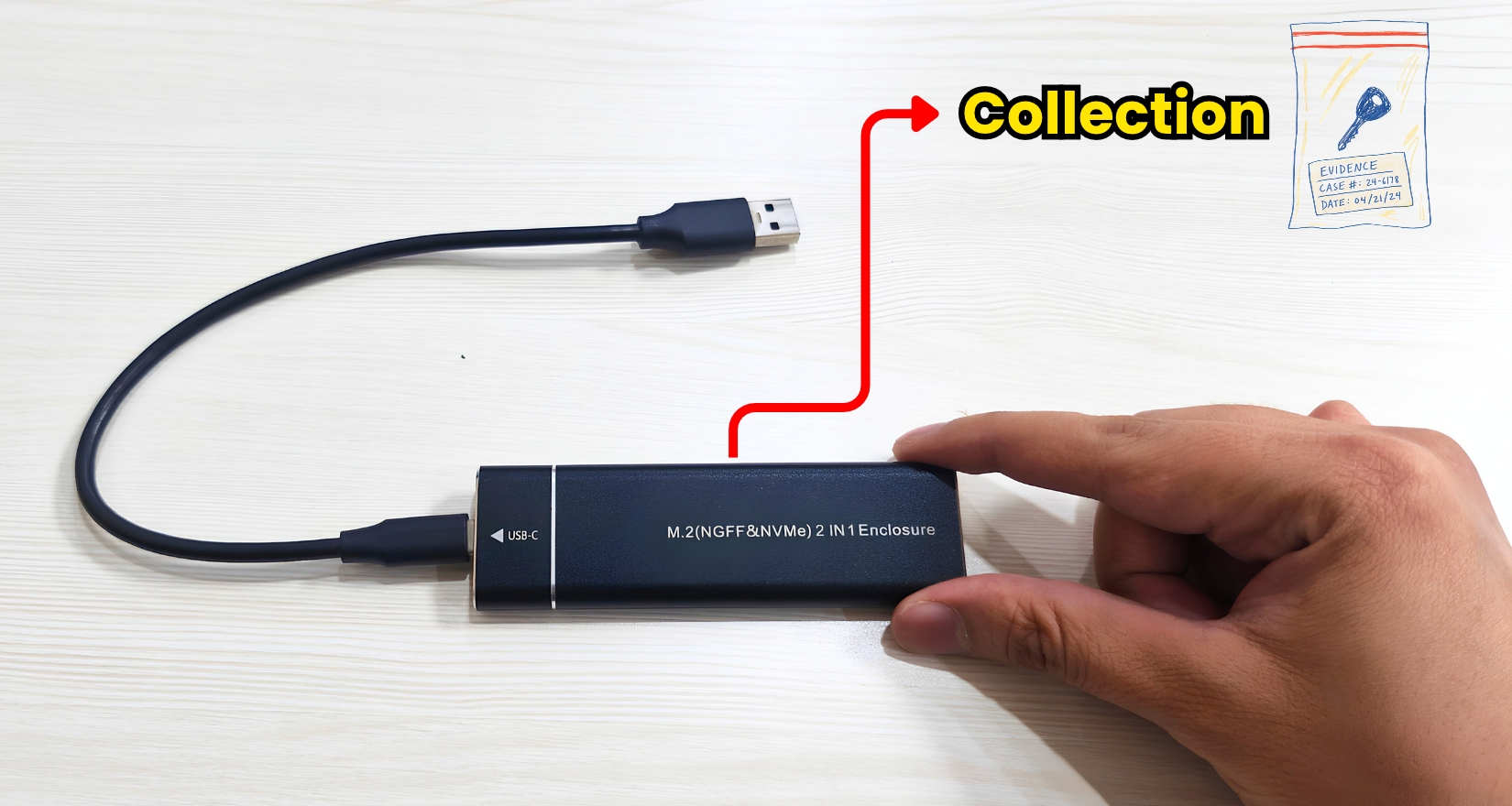
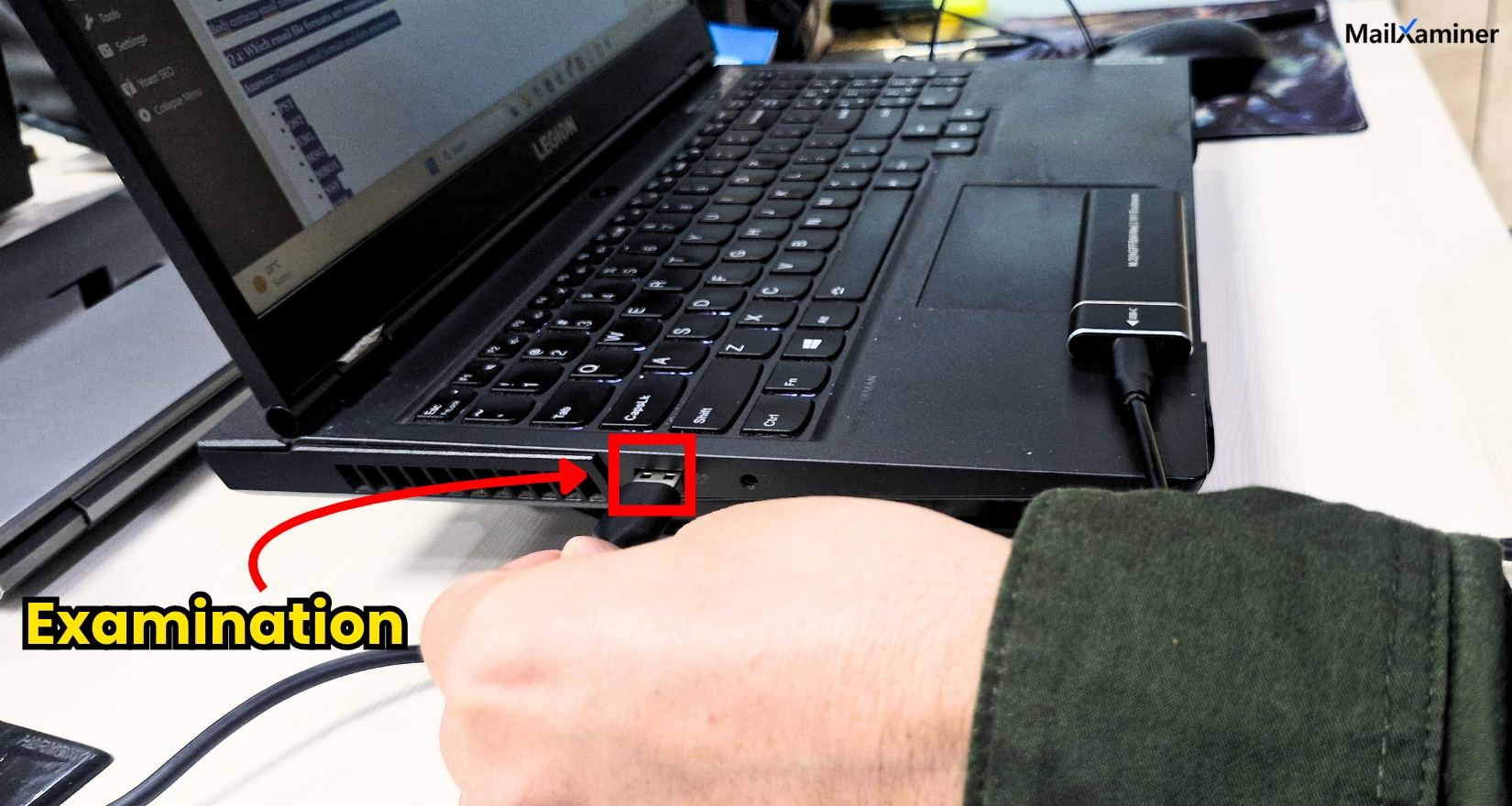
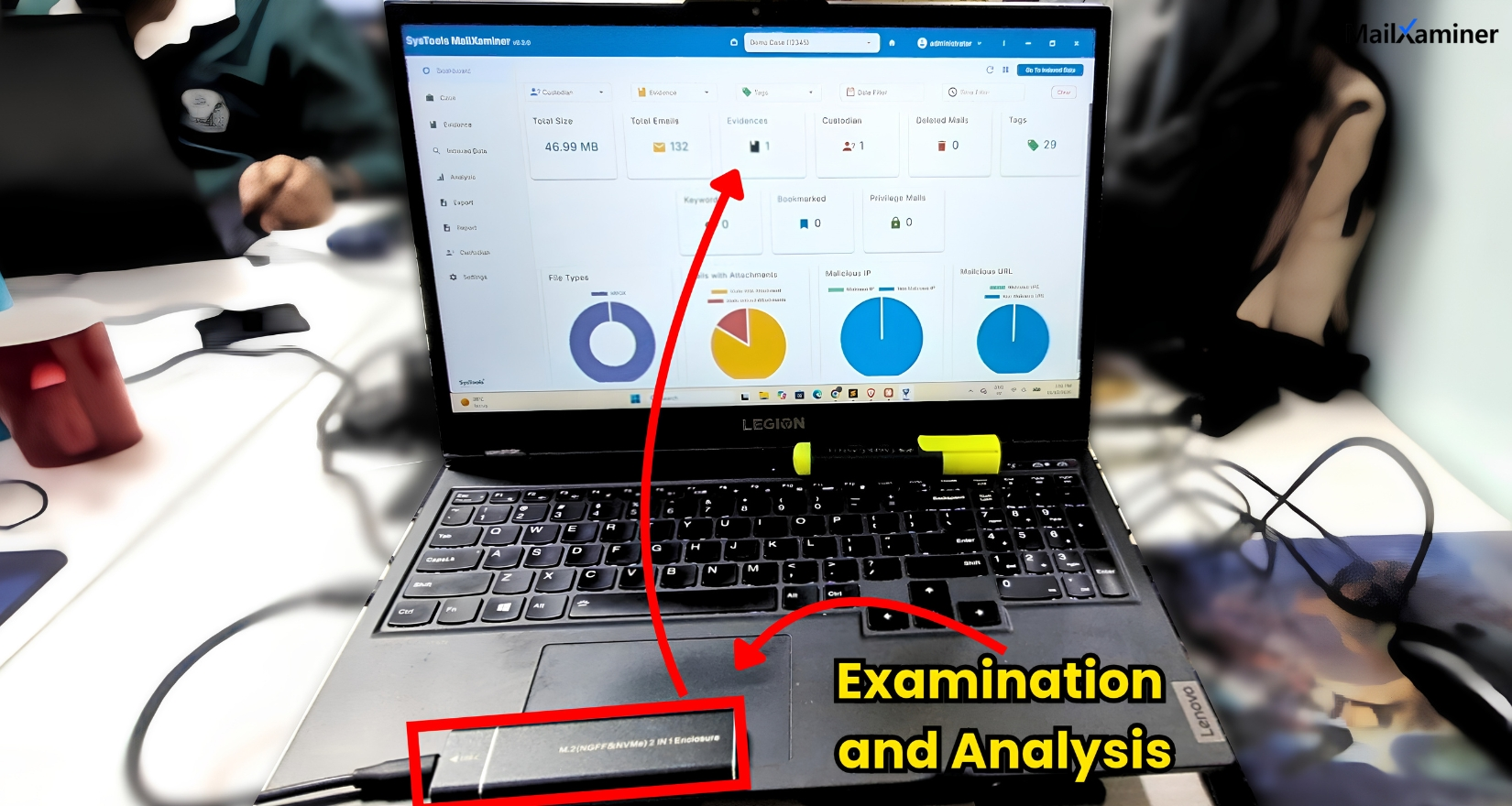
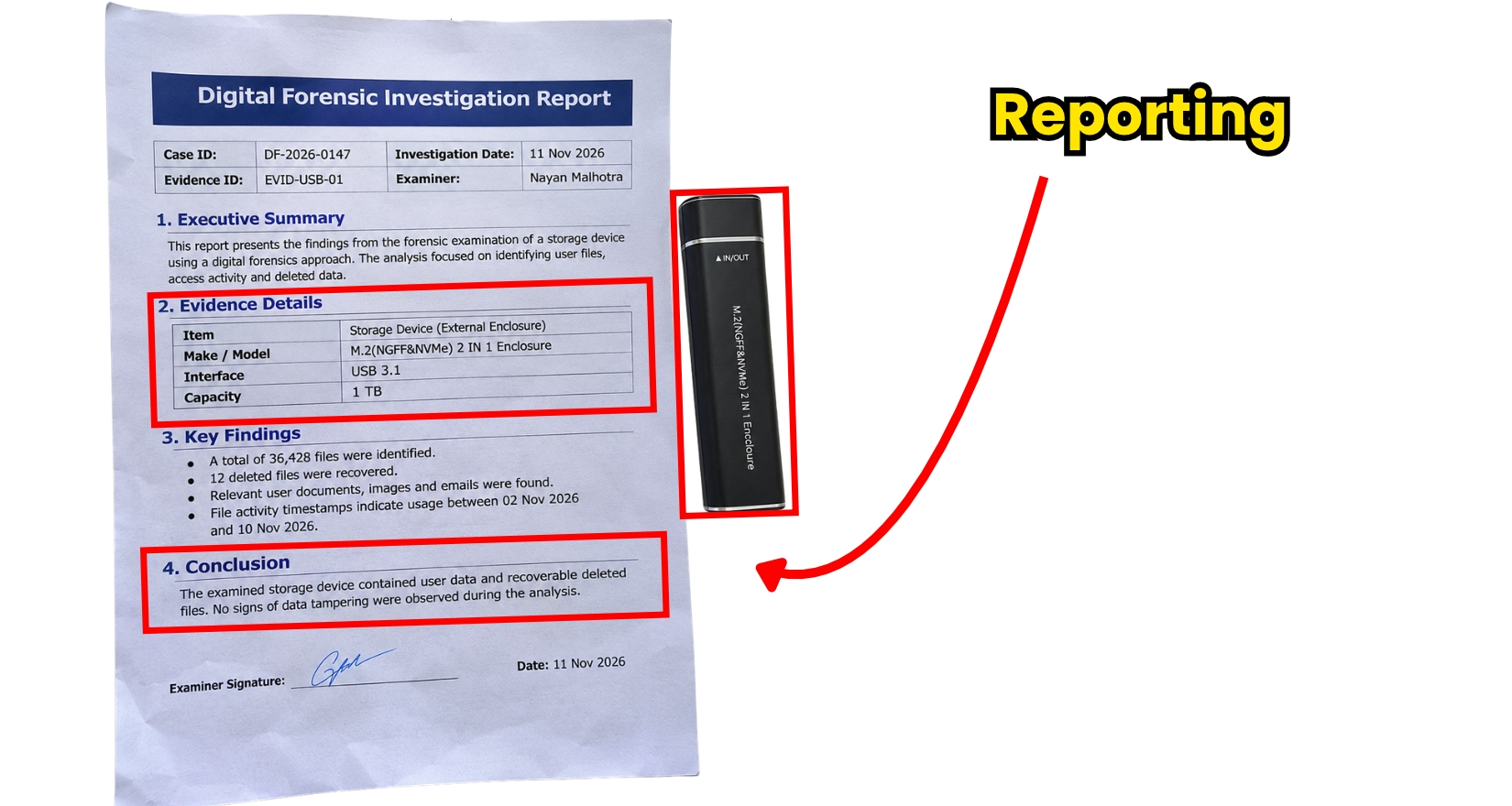
These phases can help investigators in organizing evidence handling and communicate their findings in a very systematic manner.
Q 4: Can an investigator recover deleted files during digital forensic investigation ?
Answer: Deleted files can be recovered using forensic examination techniques. Such as:
- File carving
- Filesystem Analysis
Recovery also depends on:
- Storage medium
- Overwriting
- Encryption
- Surviving data
Digital Forensics Interview Questions and Answers Regarding Tools, Technical, and Scenario-Based
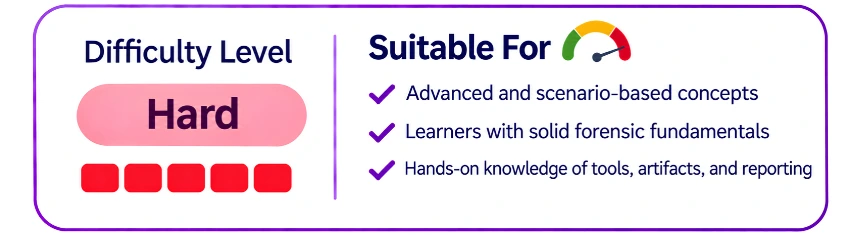
Investigators use specialized tools and methods for digital evidence analysis to identify relevant information. These interview questions are for senior level roles and covers:
- Commonly used forensic tools and their applications,
- Technical concepts like metadata that help investigators understand digital evidence.
Q 1: Which tools are mostly used in digital forensics, name some common tools ?
Answer: Tools like Autopsy, FTK Imager, EnCase, MailXaminer. Investigators opt for tools according to their evidence type and requirements of investigation.
Q 2: What is Autopsy used for ?
Answer: Autopsy is an open-source digital forensics platform used in examination of storage media and investigation of digital artifacts. It supports activities like:
- File analysis
- Keyword searching
- Timeline examination.
Q 3: What is metadata ?
Answer: Metadata is information that shows us digital file or record. Information that meta data contains are:
- Creation date
- Modification date
- Author, size
- Other properties.
Investigators use it to understand file history and context.
Q 4: What is file carving ?
Answer: File carving is data recovery technique that helps in identification and extraction of files using recognizable file structures or signatures. It help in recovering files when filesystem information is missing.
Q 5: What are Windows Registry artifacts ?
Answer: Windows Registry artifacts are records stored in Windows Registry that has configuration and system-related information. Investigators have to do a proper investigation of them to understand:
- User activity
- Device settings
- Operating-system behavior.
Q 6: What is timeline analysis in digital forensics investigation ?
Answer: Timeline analysis arranges digital events systematically or chronologically using timestamps from different evidence sources. It helps investigators in reconstruction of activities and sequence of events surrounding incidents.
Q 7: What would you do first as investigator when examining a powered-on computer?
Answer: First, I will assess computer’s current state. Once this is done I will check whether volatile evidence can be lost. I will then:
- Document its condition
- Follow investigation procedure
- Collect relevant live data when appropriate before deciding how to handle device.
Q 8: What counts for admissibility of digital evidence in court ?
Answer: Digital evidence must meet legal requirements for relevance, authentication, reliability, and proper handling. Admissibility depends on the jurisdiction, circumstances of collection, and relevant rules of evidence.
Q 9: What should digital forensic investigation report have?
Answer: Forensic report should always include:
- Investigation objective
- Evidence details
- Acquisition methods
- Tools used
- Examination findings
- Conclusions.
It should also document limitations and distinguish observations from interpretations.
Email Forensics Interview Questions and Answers
Email forensics is highly used area of digital forensics as most evidences related to any wrong activity in businesses are extracted and found deep in an email communication. It focuses on examination of:
- Email messages,
- Email header analysis,
- Attachments
- Metadata, and mailbox data.
Email forensics interview questions and answers cover these concepts and practical situations candidates can face when applying for email investigation roles. The following questions are organized into groups and part of those groups.
Email Forensics Questions (Group 1) (Part 1)
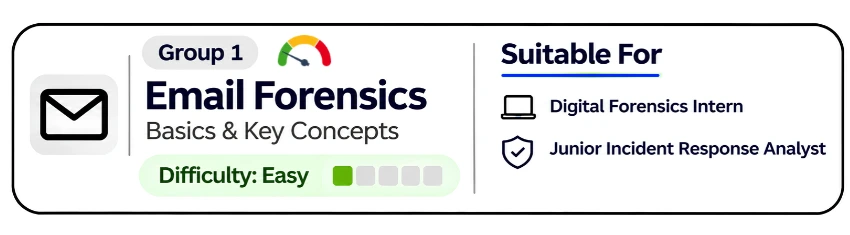
Q 1: What do you think is Email forensics ?
Answer: Email forensics is process of
- Identifying
- Preserving
- Collecting
- Examining
- Analyzing
Email evidence. It helps investigators understand communication patterns and examine relevant message data.
Q 2: How an email travel from sender to recipient ?
Answer: When someone sends an email, their email app sends it to mail server. Server uses SMTP to transfer message to the recipient’s mail server. DNS MX records locate that server, which then delivers email to the recipient’s mailbox.
Q 3: Email header and its body what is the difference between the two ?
Answer: Email header has information like:
- Sender
- Recipient
- Subject
- Date and Time
- Routing details.
Body contains email message content and include text, images, and attachments.
Q 4: Which email file formats are commonly examined?
Answer: Common email formats and data sources are:
- PST
- OST
- EML
- MSG
- MBOX
- NSF
- EDB.
These format’s structure and examination methods are different depending on the email client or platform.
Q 5: Brief the difference between PST and OST files ?
Answer: PST files are used to store Outlook emails locally, create archives, and export mailbox data. OST files store synchronized offline copy of mailbox data, this allows user to access their emails without internet connection.
Email Forensics Questions (Group 1) (Part 2)
Q 6: How forensic copy different from normal email copy ?
Answer: Forensic collection follows documented method to preserve email data and metadata. Normal email copy can miss important information and do not always record how evidence was collected and verified.
Q 7: What is major difference between email forensics and eDiscovery ?
Answer: Email forensics examines emails to understand: what happened and identify relevant evidence. eDiscovery focuses on identifying, preserving, reviewing, and producing electronically stored information that is needed in legal matters.
Q 8: Who performs email forensic investigations ?
Answer: Email investigations are performed by:
- Digital forensic examiners,
- Incident responders
- Law enforcement professionals
- Corporate investigators
- Legal teams, and eDiscovery specialists.
Depending on their authority and responsibilities.
Q 9: What is email metadata?
Answer: Email metadata is information that is associated with message, including:
- Timestamps
- Sender
- Recipient fields
- Message-ID
- MIME details.
Investigators use it to examine communication context and timelines.
Q 10: Why email forensics is important?
Answer: Email forensics helps in investigation of
- Phishing
- Fraud
- Corporate espionage investigations,
- Data leakage
It allows investigators to examine communication records and identify information relevant to case.
Questions Regarding Email Headers and Authentication (Group 2) (Part 1)
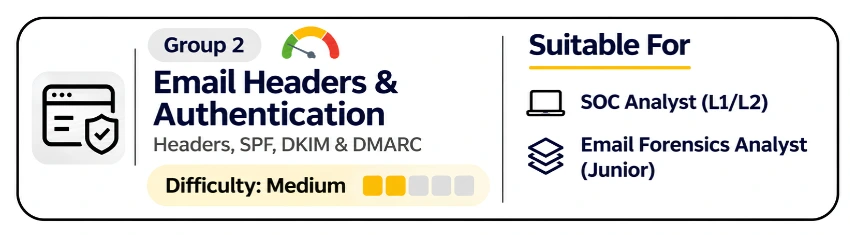
Q 11: How do you trace suspicious email?
- Answer. Preserve original message
- Inspect trusted Received hops,
- Compare From and Return-Path,
- Review Authentication-Results
- Normalize timestamps, and correlate with provider and gateway logs.
- Never treat every header line as trustworthy.
Q 12: What does SPF verify ?
Answer. SPF checks connecting IP is authorized to send for the SMTP envelope domain or HELO identity. SPF pass do not always prove visible From address belongs to sender or that message is harmless.
Q 13: Why Received headers are examined from bottom to top?
Answer: Mail servers add new Received fields at top of email header, leaving earlier entries below. Investigators can reconstruct route by examining sequence while identifying untrusted or potentially forged entries.
Q 14: How DKIM work ?
Answer. DomainKeys Identified Mail (DKIM) uses cryptographic signature over selected headers and message content, verified with a public key published in DNS. Valid signature supports domain-level signing and integrity of signed material, not identity of the human author.
Q 15: What DMARC add to SPF and DKIM?
Answer. DMARC evaluates that do SPF or DKIM passes with alignment to visible From domain and publishes domain policy. Pass do not exclude compromised legitimate accounts or malicious messages.
Questions Regarding Email Headers and Authentication (Group 2) (Part 2)
Q 16: Can a phishing email pass SPF, DKIM, and DMARC?
Answer: Yes. phishing email sent through compromised account or attacker-controlled authenticated domain can pass all three checks. Investigators must examine message and surrounding account activity.
Q 17: What is display-name spoofing?
Answer. Displayed sender name impersonates trusted person while email address differs. Compare full address and trusted message metadata rather than relying on display name.
Q 18: What is domain spoofing?
Answer. Domain spoofing is an attempt to make a message looks associated with domain not controlled by sender. Header and authentication checks help identify some forms, but same-looking domains are separate problem.
Q 19: What does Message-ID prove?
Answer. Message-ID is message identifier usually generated by sending software. It can aid correlation and duplicate detection, but it can be forged or absent and is not unique proof of authenticity.
Q 20 Can an email header reveal the sender’s exact location?
Answer. Not reliably. Headers can show:
- Mail servers
- Relays
- VPNs
- Cloud infrastructure rather than user device.
Geolocation of an IP is approximate and cannot identify person on its own.
Email Evidence Preservation, Recovery and Investigation Questions (Group 3) (Part 1)
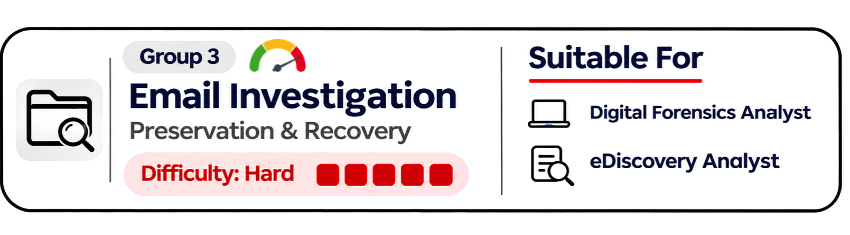
Q 21: What is chain of custody ?
Answer. Chain of custody is:
- Documented record of evidence collection
- Possession,
- Access
- Transfer
- Storage
- Handling.
- Record item identifiers
- Custodians
- Dates
- Methods
- Locations
- Integrity checks.
Q 22: Why SHA-256 hashing used?
Answer. SHA-256 digest provides practical way to compare evidence bytes in stages. Matching hashes strongly support byte-for-byte consistency; they do not establish lawful acquisition, original authenticity, or complete collection.
Q 23: When evidence hashes are calculated?
Answer. Calculate hashes as early as practicable during acquisition, record algorithm and values, and verify again after transfers or before examination where relevant. Document any expected changes to working copies.
Q 24: How to preserve mailbox for investigation ?
Answer.
- Define scope
- Apply appropriate retention and legal holds where available
- Acquire relevant mailbox data and logs
- Preserve native metadata
- Document procedures,
- Protect source and working copies.
Q 25: How legal teams design defensible email searches?
Answer.
- Define custodians
- Date Ranges
- Concepts and proportionality with counsel
- Test queries against sample data
- Document revisions
- Validate whether searches retrieve relevant material
Email Evidence Preservation, Recovery and Investigation Questions (Group 3) (Part 2)
Q 26: What are first steps after suspected business email compromise?
Answer. Starting steps to be taken in suspected business email compromise are:
- Contain ongoing risk.
- Verify payment requests via trusted channel.
- Preserve messages and account logs.
- Review sign-ins and forwarding rules.
- Coordinate properly with security, finance and legal teams
This is one of the important digital forensics interview question.
Q 27: How will you investigate possible employee data leakage?
Answer. In email forensics interview questions this is the commonly asked one. Investigator should start with obtaining authorization, preserve relevant mailboxes and logs, search outbound communications and attachments, use general search in forensics tool. Once this is done investigator should correlate access records and document explanation and the same time protect employee privacy.
Q 28: How to build an email communication timeline?
Answer. Investigator should normalize timestamps, correlate sent and received records, thread relates messages and cross check logs.
Note: Missing data and uncertainty rather than treating timeline as complete.
Q 29: How can investigators link multiple scam emails ?
Answer. Compare infrastructure, message structure, headers, URLs, attachments, identifiers, language, and timing. Similarities can suggest campaign but do not attribute message to one actor.
Prepare Further For Digital Forensics Interview
Preparing for an email or digital forensics interview needs more than understanding few basic concepts. Candidates actually practice this on professional tools to be prepared. This results in receiving many queries by students as they show interest in our email forensics software so they can be prepared.
Universities who teaches forensics also show interest for the same so they can teach with more effectiveness, preparing digital forensics interview questions and answers is good. Applicants should always practice what they are learning.
Frequently Asked Questions
Q: Why email forensics is necessary ?
A: It helps reconstruct communications and preserve evidence in fraud, security, workplace and legal investigations.
Q: When should an email forensic investigation begin?
A: As soon as relevant incident or preservation duty is identified, after appropriate authorization and scoping.
Q: Can deleted email always be recovered?
A: No. Recovery depends on source, retention, backups, and surviving artifacts.