Corporate Espionage Investigations: How Investigators Uncover Hidden Data


An investigation that happens when a company spots that its confidential data has reached its competitor. When a company conducts research to find the leakage, this investigation is known as corporate espionage investigations. In this process, investigators face challenges as they have to investigate.
- Large volume of emails.
- Scattered files
- Hidden communication trails.
- How the information left the organization
Finding one real leak can sometimes feel like a search for one fingerprint in a warehouse of evidence. In this write-up, we will show how investigators uncover the data theft inside emails and how modern forensics reveals the truth.
What Is Corporate Espionage
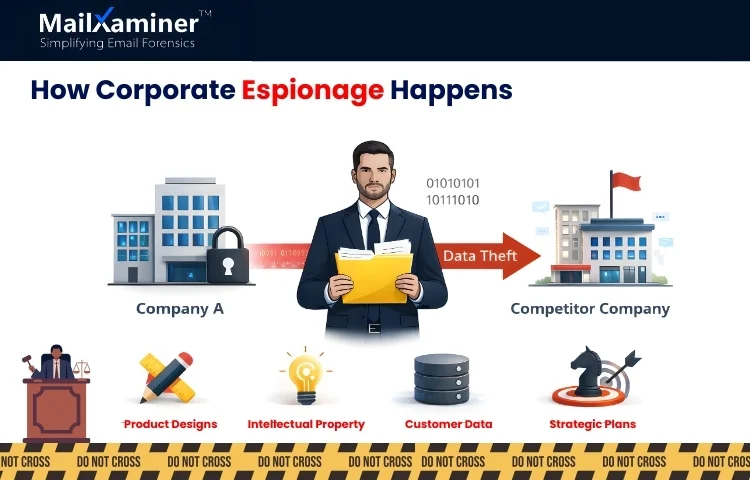
Industrial espionage or corporate espionage can be mentioned as the unauthorized acquisition of highly confidential business information for competitive advantage. The information can be.
- Product designs
- Intellectual property.
- Customer databases
- Financial strategies
- Upcoming plans
In this highly competitive business environment which is not less than an economic warzone. Companies invest millions in research and development. When a competitor gets access to this information illegally, the strategic, creative, and financial damage is huge.
This can occur through external cyberattacks or insider threats. In the majority of the investigations, insider threat is the primary focus, as employees have access to sensitive data.
How Corporate Espionage Investigations Are Executed
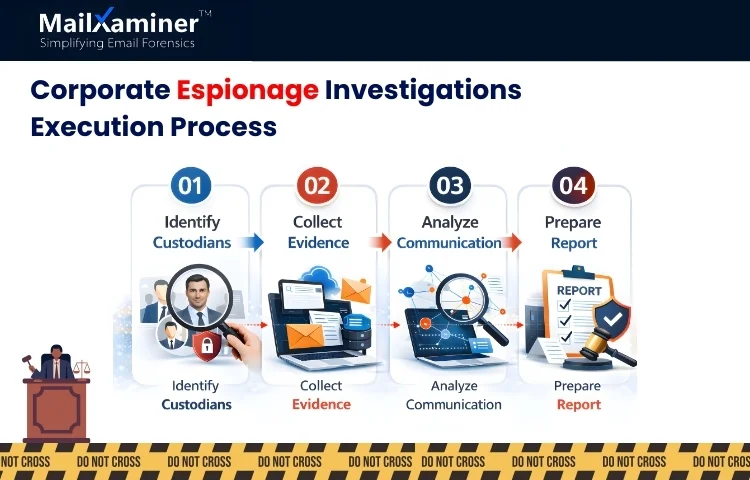
When a company spots espionage, investigators have to follow a structured digital forensics process. The major goal of this process is to track the movement of sensitive data and identify individuals involved. The stages of research include:
- Stage 1 – Employees and departments are investigated who had access to the leaked information. These individuals are called custodians in forensic investigations
- Stage 2 – In corporate espionage investigations, the next stage is the collection of digital evidence from sources such as email systems, cloud storage platforms, internal communication tools, and employee devices.
- Stage 3 – After data collection, investigators begin analysis of communication patterns, document transfers, and activities. The objective is to examine how the confidential information moved outside the organization.
- Stage 4 – In this stage, the findings have to be documented in the form of reports that can be utilised in legal proceedings and internal disciplinary actions.
Related read – Make forensically sound copies of the digital information
Common Channels Used in Investigation
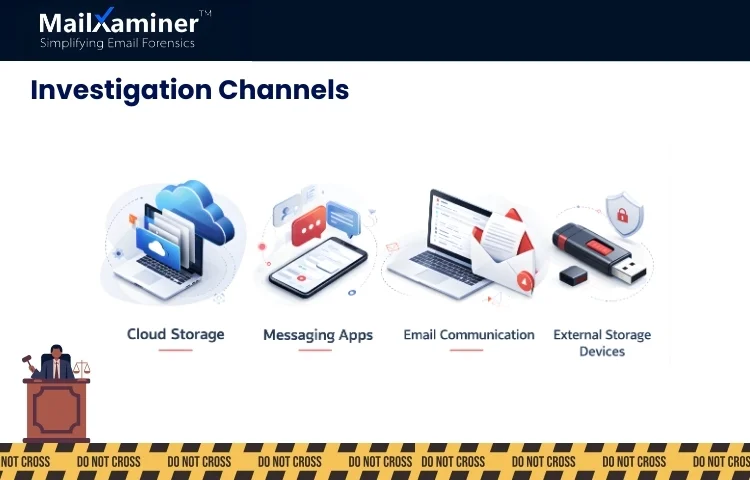
Corporate espionage does not happen through a single channel. Investigators have to examine multiple sources of data in an investigation. These channels are:
- Cloud storage platforms – Where employees can upload confidential documents and then share them externally.
- Messaging apps – Apps used in team collaboration where screenshots or files may be exchanged.
- Email communication – Which contains a detailed record of conversations, attachments, files and communication patterns, and sometimes the scanned pictures of documents which can be analysed through OCR analysis.
- External storage devices – Flash drives and hard drives that allow employees to copy sensitive files.
In corporate espionage investigations, emails frequently become one of the most important evidence sources as it preserves technical information such as timestamps, message routes, and sender identities.
Related Read – Current Challenges in Digital Forensics Investigations
Why Email Evidence Becomes Critical
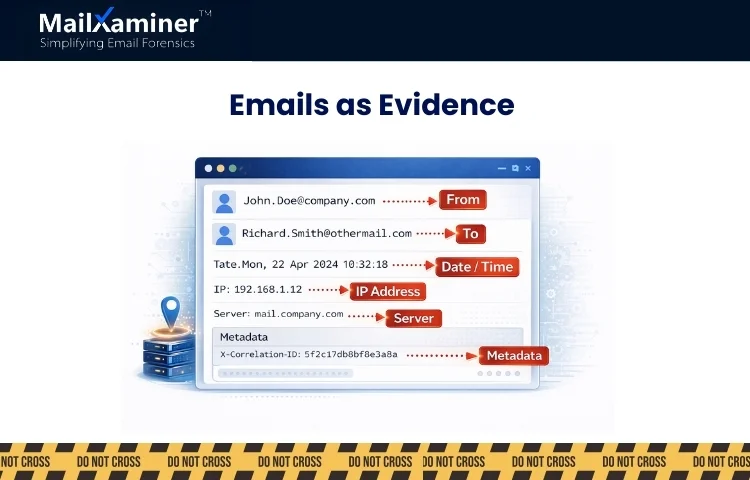
Emails plays an inseparable part of business communications. In emails every message records even the minutest details like:
- Who sent it
- Who received it?
- When it was transmitted.
Even when the message is deleted or modified, technical details known as metadata remain intact. These tiny details help investigators in the reconstruction of communication timelines. Emails contain attachments that include confidential files like contracts, reports, or designs. Analysis of these messages and attachments helps investigators in the identification of how sensitive information moved beyond the company boundaries.
Related read – Authenticate emails for evidence (step-by-step)
Mapping Hidden Communication Patterns
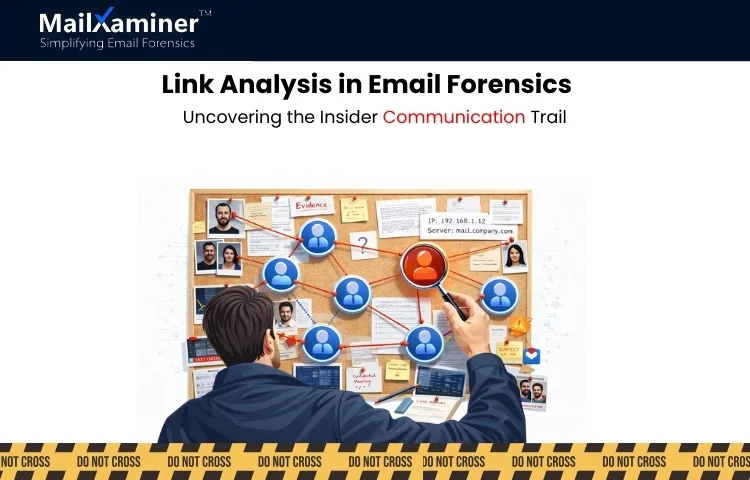
In corporate espionage investigations, many investigators use email forensics software, which provides link analysis. This technique analyses the communication relationship through email datasets between the individuals who communicated with whom.
This can be thought of as a detective placing pictures of suspects on a board and connecting them with the red strings. Each step represents a relationship between two people. In digital investigations, this analysis acts the same as it maps email communications between employees, domains, and IP addresses.
Detection of Tampered or Altered Emails
Individuals involved in data leakage attempt to hide their actions by modifying digital records. Investigators examine email metadata to detect such manipulation. Metadata includes technical fields like:
- Creation dates
- Modification Timestamps.
- Server routing information.
By researching and comparing these fields, investigators can find out whether an email has been altered after its creation. This type of analysis maintains the integrity of digital evidence.
Discovering Hidden Evidence in Attachments
In many cases, confidential information is shared via attachments such as scanned documents, screenshots and images. In many cases, the text inside the scanned document is not searchable as it exists as part of an image.
Investigators use technology named Optical Character Recognition (OCR) to extract the text from the images and scanned files to make it searchable. This becomes useful when individuals attempt to disguise sensitive data inside images and photographs.
Maintaining Evidence Integrity
We hope that from the above information, you have some clarity on corporate espionage investigations and how they are performed. For digital evidence to be accepted in court. Investigators must ensure it has not been altered during the analysis phase.
Hash verification methods, such as MD5 hashing, act as digital fingerprints for files. Through this hashing, investigators must ensure that it has not been altered during the analysis. Maintaining this integrity is extremely important in corporate espionage cases where evidence may be presented in court later.
Conclusion
Corporate-level investigations need a careful approach as sensitive information moves through multiple channels like cloud platforms, messaging apps, emails and external devices. Advanced investigation platforms can help investigators in analysing large datasets, visualising communication networks and extracting digital evidence efficiently.
If an investigator combines structured forensic methods with specialised analysis tools. Organizations can uncover threats and protect their most valuable information.
Frequently Asked Questions
Q – What is a corporate espionage investigation?
A – It is of identifying how confidential business information was stolen and passed on to the competitor, and who was responsible for this data leak.
Q – How can investigators analyse large volumes of email evidence?
A – Investigators use specialised professional tools to investigate communication patterns and evidence to enlarge the volume of email data.