Email Forensics Handbook: Practical Guide for Lawyers, Investigators, and Students


Blog Overview: Email forensics is the process of collecting, preserving, examining, and interpreting email data so correct information can be identified. Email forensics helps in:
- Explanation of an event
- Investigation of suspicious activity or legal matters
Email, if seen from a naked eye, is just like a simple message in an inbox on your device’s screen. Technically, an email is a complex combination of technical headers, timestamps, attachments, routing information and related mailbox records. This provides clues how message was handled and what happened around it.
For investigators, forensic students and lawyers understanding this complex combination makes it easier to untangle email evidence carefully. In this email forensics handbook or guide we will explain email forensics from ground up.
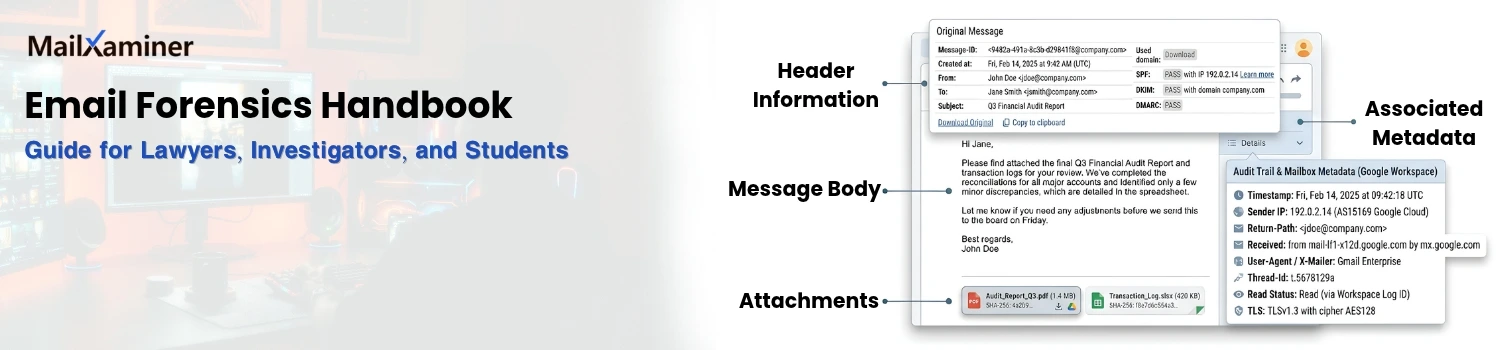
Quick answer: Email forensics examines email messages and it’s digital records to find out evidence. Email forensics helps in investigation of fraud, phishing, cybercrime, corporate espionage investigations and other cases involving email communication. Reliability of investigator’s findings depends on available data, examination tools, methods and the direction in which results are expected.
What Is Email Forensics?
Email forensics is a part of digital forensics that focuses on investigation of email messages, mailbox data, attachments, and other related records to find digital evidence through email examination to uncover the truth. Investigators examine both message and available digital traces surrounding it.
Imagine that an employee receives an email from someone claiming to be company’s finance director. Message requests urgent payment to be made to a vendor and email has a new bank account number in which payment is to be transferred.
Employee working in accounts department recognizes director’s name and approves the transfer.
Forensic examination helps answer several questions:
- What address is in sender’s field
- Which mail servers handled this message
- Authentication results show something suspicious or not.
- Do Email message have any links or attachments that need detailed examination?
- Investigate related emails that help explain payment request?
- Independent records support sequence of events?
- If email contains any embedded image, finding where a photo was taken.
These questions helps in generating investigative lead through suspicious emails, if examined systematically and deeply.
Why Email Forensics Is Used
In this email forensics handbook, we will see why email forensics is used. It is used whenever email communication contains an evidence of any event, decision, transaction, or suspicious activity. That evidence is required to prove truth in court or business matters so case can be solved and justice gets delivered.
Common applications are:
| Use Cases | What Examination Helps Reveal |
|---|---|
| Phishing and email fraud | Sender information, malicious links and related messages. |
| Business email compromise | Wrong payment instructions, impersonation and changes to payment details. |
| Corporate Investigations | Policy breach, unauthorized communications, potential data disclosures. |
| Cybercrime Investigations | Messages, false attachments, technical records related to criminal activity. |
| Legal disputes | Transaction history and series of communication. |
| Internal incident response | Possible entry points, affected accounts, scope of email related incident |
For example, if company finds that confidential documents got shared without permission. Investigators can examine
- Messages and attachments
- Recipients, and available mailbox records.
Goal is to find out what was shared, who received it and transfer was authorized or not.
Related Read: How to Investigate a Suspicious Email
What Evidence Email Forensics Examine
It is important for forensics students to understand that a typical email investigation involve different types of evidence on which investigators work:
- Email Headers: Technical fields of an email that contain information about message, sender and its handling by mail systems.
- Message Content: Text that is displayed on the screen of receiver. Message that is seen by receiver.
- Timestamps: Sequence of events, record of date and time.
- Attachments: Documents, PDF and other files attached in email.
- Metadata: Information such as identifiers, properties, authentication results and other technical details.
- Mailbox records: Stored messages, folders, and available artifacts from suppressed email sources.
- Related records: Server logs, account records, backups and other details that help verify findings.
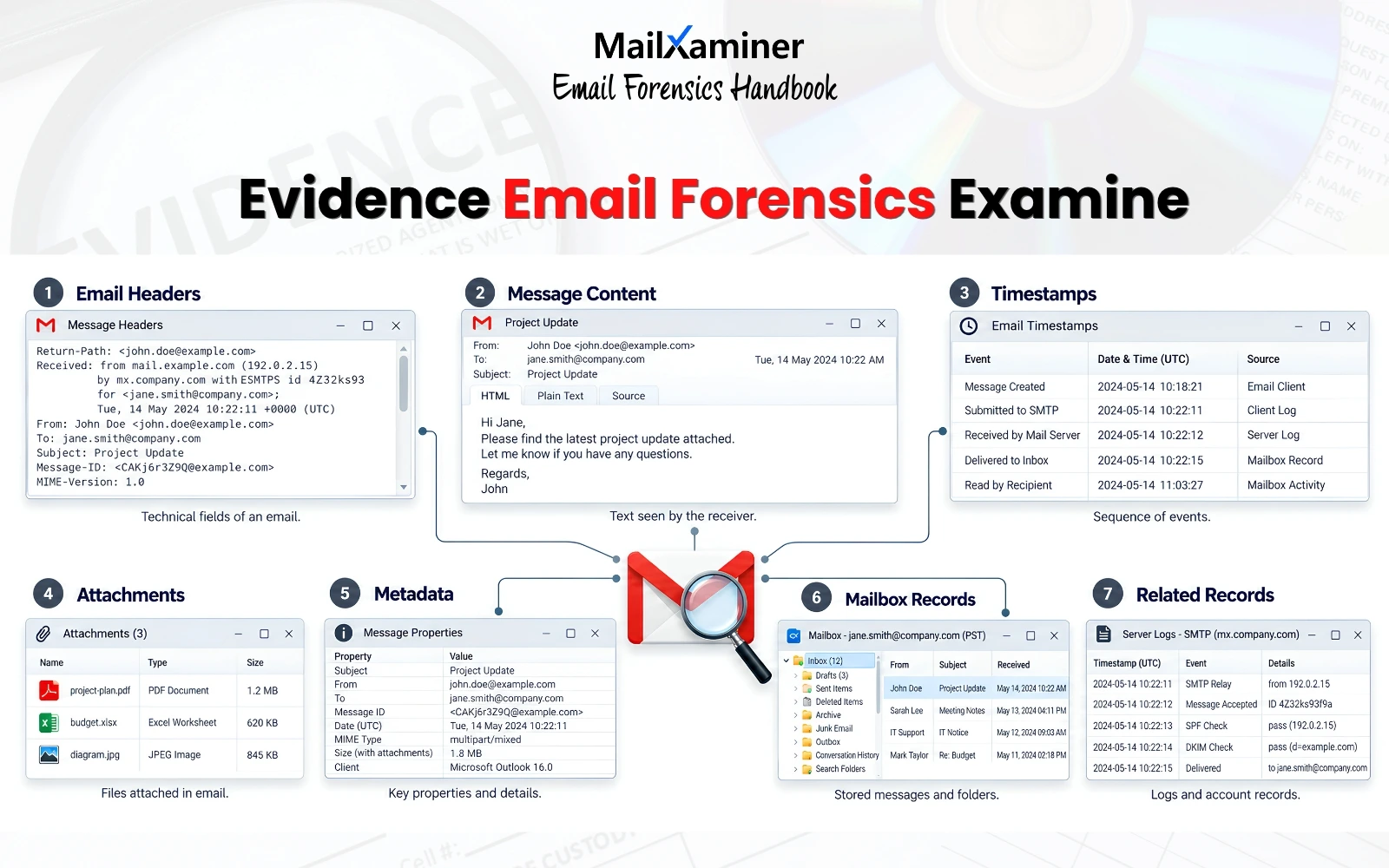
Not every investigation have access to all these sources it depends on investigation. Available evidence depends on collection method, storage system and legal authority. It is important to understand few things:
- Sender’s address do prove who typed the message.
- IP address do not directly reveal person’s physical location.
- Matching file has do not independently prove that data was genuine
Note: Reliable findings come from interpreting multiple pieces of evidence together.
How an Email Forensic Investigation Works
Email forensic investigation follows structured and simple process:
- Define investigative question with clarity.
- Get an appropriate authority.
- Identify and preserve important and relevant data.
- Examine available evidence.
- Correlate extracted findings.
- Document conclusions clearly.
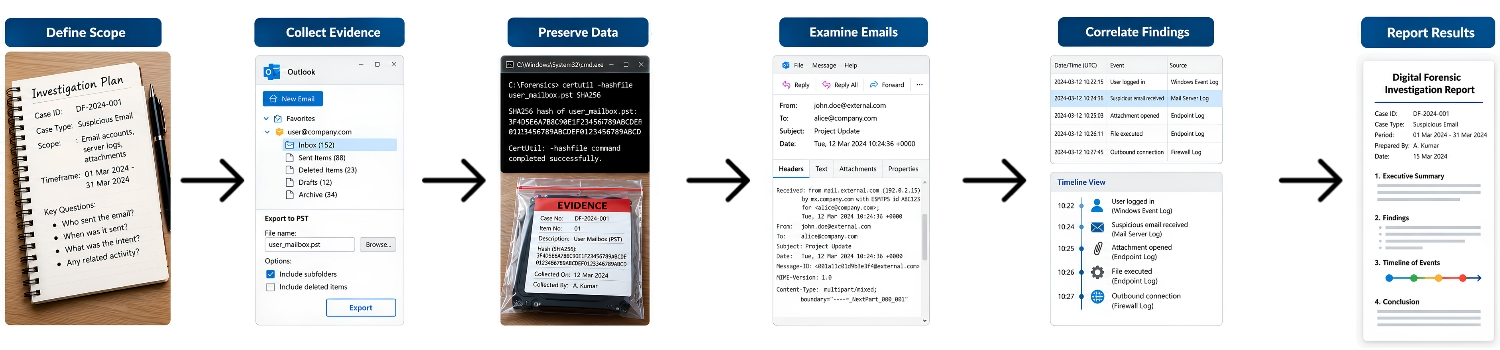
The exact procedure depends on the nature of case. Investigators should have a clear purpose of each stage. Skipping even one small step can make results more difficult to verify.
How to Conduct an Email Forensic Investigation
This process will provide investigators and forensic students practical starting point for authorized email examination. Let’s have a look at this Email forensics handbook.
Step 1: Define question clearly and establish authority.
Identify what needs to be established. An investigation of a fraudulent payment transfer will have different goals. Investigation of confidential document leak will have different goals. Note down and have clarity on which accounts, devices, messages, and date ranges are relevant and to be investigated. Confirm legal or organizational authority for collecting data and define appropriate boundaries. Once this step is completed identification and collection of sources gets started.
Step 2: Identify and collect relevant sources.
Sources like EML, MSG files, PST or OST mailbox files, MBOX archives, cloud email data, existing forensic images, backups, and relevant server records. Select sources based requirements of case. When cloud services are involved, account for provider access procedures, retention policies, export methods, and any applicable legal requirements. Collection method should preserve relevant information. Always document what all was obtained, from where, when, and by whom.
Step 3: Preserve evidence.
Preserving protects evidence from alteration and helps explain clearly how it was handled. Where appropriate:
- Retain original source
- Create controlled forensic copy
- Calculate cryptographic hash
- Document the process.
Hash such as SHA-256 verifies that file remains unchanged between checks. Matching hash supports integrity verification for data being compared.
Note: It do not prove that file was authentic before it’s collection or that every part of the collection process was correct.
Maintain proper chain-of-custody record showing: Who received, handled, transferred, and examined an evidence. Record relevant actions, dates, times, tools used, and results clearly.
Step 4: Examine and search the email data.
Once evidence has been collected, examine relevant messages and their technical structure.
- Search terms
- Date ranges,
- Sender and recipient addresses,
- Subject lines,
- Filenames, and attachment content
Proper and detailed examination can help narrow large collection. Each search should be based on the investigative question.
For example, an investigator examining a suspected data leak might search for a project name, a document filename, and the external address believed to have received the information. A search result is a lead, not a conclusion. Review the surrounding conversation and relevant original data before interpreting a match.
Step 5: Correlate evidence.
In this email forensics handbook, it’s time to compare message content, technical fields, attachment information, timestamps, and available records. Suppose an email is sent at 10:05 a.m., Relevant server record shows it was received at different time. This difference can be due to time-zone differences or mail processing, or it may require further examination. Record original times, account for relevant time zones, and document reasoning that can be used to reconstruct the sequence.
Step 6: Report What Evidence Shows
Useful report clearly explains scope of an examination, source data, methods used, findings and any limitations. Distinguish direct observation from interpretation. Clear report allows qualified person to understand examination and assess basis for its conclusions.
Which Technical Clues are Important in Email Forensics
Email contains many technical elements that help answer different investigative questions. Understanding what each element is important as any part that looks normal to non-technical reader can have a narrower meaning.
Email Headers: Email headers have structured points that provide information about message, while mail servers add routing records as message moves through delivery process. The Internet Message Format is defined in RFC 5322. It describes the structure of message headers and bodies.
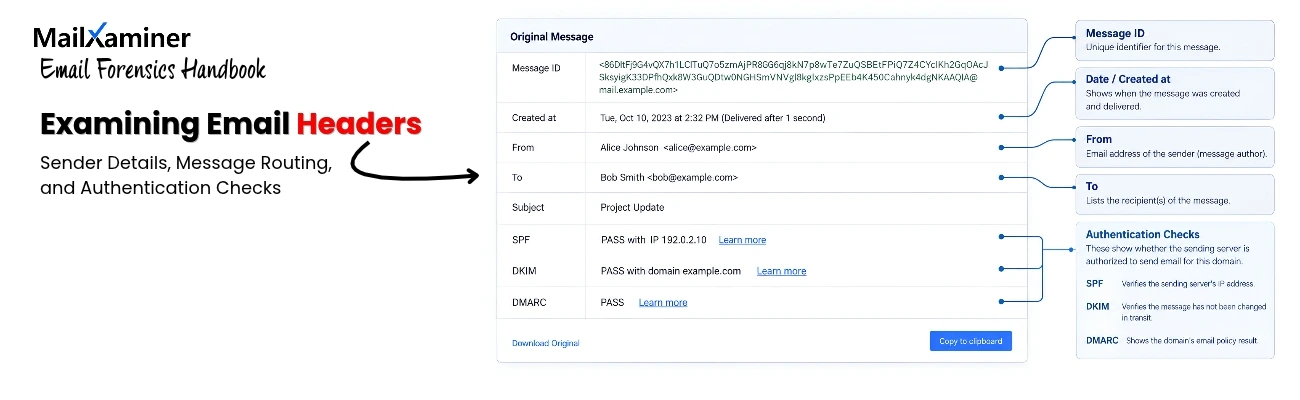
Here are some commonly examined fields:
| Field | What It Shows |
|---|---|
| From | Address presented as message author |
To and Cc |
Recipients |
| Date | Date and time specified for the message |
| Received | Record added by mail server that handles the message. |
| Return Path | Return address on where to send error message of it is not delivered to recipient. |
| Message ID | Identifier intended to distinguish the message. |
These fields should be analyzed and worked on together. Visible From field can be forged and the Message ID is not verified identity certificate. Investigators should always use trusted entries to reconstruct route and check reliability of these fields. In big investigations, investigators use email header analyzer tools to investigate and come to conclusions more predictably.
How SPF, DKIM, and DMARC Help Investigate Suspicious Emails?
SPF, DKIM, and DMARC are three security checks that help find out whether an email is associated with domain it claims to come from. Each checks something different.
- SPF (Sender Policy Framework): Checks sending server. It checks the server sending an email is authorized to send email for the relevant domain.
- DKIM (DomainKeys Identified Mail): Checks digital signature. It uses digital signature to verify that message is associated with signing domain and that the parts covered by the signature have not been changed.
- DMARC (Domain-based Message Authentication, Reporting, and Conformance): Checks domain alignment. It checks whether domain shown in visible From address matches domain authenticated through SPF or DKIM. It also tells receiving email systems what action to take when checks fail.
Passing all three checks do not prove that finance director personally sent an email we discussed or that its contents are trustworthy. Investigators must examine headers, message content, and other available evidence before concluding.
Examine Attachments and Metadata
Attachments can contain important evidence that is not visible in email body.
PDF can contain invoice details. Word document can include properties identifying its author or modification history. Photograph can contain visible addresses, signs, or location-related metadata. Examination should consider file’s actual content, format, context, and relevant available properties. Metadata should also be interpreted carefully. It may be missing, altered, removed during export, or generated by system that does not reflect event an investigator is trying to establish.
When an attachment matters in a case, preserve original file and document any extraction, conversion, or other processing performed. The next technical clue in email forensics handbook we are covering is OCR.
Use OCR and Photo Location Data Correctly
Optical Character Recognition (OCR) converts text visible in image into machine-readable text. This technology allows investigators to search image-based attachments for readable words, numbers, addresses, and other clues.
Imagine an email is embedded with photograph of printed invoice. Invoice number is visible in image, but ordinary text search cannot find it because the number is stored pixels rather than searchable characters.
OCR recognize the number and make it searchable, helping investigator locate relevant attachment. However, OCR and photo geolocation are two different techniques.
| Technique | What It Helps Establish |
|---|---|
| OCR | Readable text present in an image |
| EXIF analysis | Available metadata associated with photograph. |
| GPS metadata examination | Coordinates embedded in an image, when present. |
| Visual Analysis | Possible clues from signs, landmarks and visible surroundings. |
If photo contains GPS data, that information help identify its recorded capture location. But many photos contain no GPS data, and metadata can be missing, stripped, and altered.
If GPS information is unavailable, visible text or landmarks may suggest a location further verification. OCR can help extract that text, but it cannot prove where a photograph was taken.
Assess Deleted Email Recovery Carefully
Deleted email data can sometimes be recovered, but recovery is not guaranteed. Results depend on:
- Storage format
- How message was deleted.
- Available backups or retained records
- Condition of evidence.
Potential sources include supported mailbox files, existing forensic images, backups, and authorized server-side recovery sources.
Deleting message from one inbox does not necessarily remove every copy from every system. However, investigator should never assume that provider, device, or forensic tool will always retain recoverable content.
When deleted records are found, document their source and distinguish recovered data from intact records. Any uncertainty about completeness should be reported. We hope this email forensics handbook helped you in making these concepts clearer
How Should Lawyers, Investigators, and Students Use the Findings?
These principles of email forensics are similar across different professions, but each audience needs to apply these findings to different practical question.
- For lawyers: Focus on authenticity, relevance, source of evidence, its integrity, and procedures required by applicable jurisdiction. Technically detailed report is useful when it explains how findings support or fail to support a specific issue in dispute.
- For investigators: Work from defined question, preserve relevant sources, examine the available artifacts, correlate findings, and document every important step. Avoid treating an automated alert or a single suspicious field as proof of misconduct.
- For students: Learn how email messages are structured before relying on specialist tools. Practice examining sample headers, identifying timestamps, understanding MIME attachments, and verifying files with hashes in an authorized lab environment. As you will practice examining sample email headers a good email headers cheat sheet will be a great thing to refer to.
- For cybersecurity professionals: Use the examination to understand the suspicious communication, identify related records, and guide an incident response. For a narrower treatment of technical analysis.
Email investigation becomes more predictable when it is performed with tools that are built for this purpose now as we approach to the end of this email forensics handbook let us see how to opt for a good tool
Choosing a Forensic Tool
A suitable tool should support evidence formats in the case, provide access to message fields, offer practical searching and attachment examination, and help organize findings for review and reporting. Modern email forensics involves large volumes of mailbox data collected from different sources like cloud mailboxes, archived servers, PST files, OST files, and backup storage systems.
Performing analysis on this data manually can take days. Due to this, investigators and agencies prefer organized forensic workflows like email forensics software for examination of suspicious communication more efficiently. Specialised platforms such as MailXaminer helps investigators organize mailbox data, examine hidden evidence and simplify large-scale email forensic investigations. Instead of searching emails one by one, investigators can focus more effectively on suspicious communication patterns, phishing activity, deleted evidence, and unusual behavior.
Wrapping Up
Emails look simple on the surface, but they contain hidden technical details which are highly capable of revealing how phishing attacks, fraud cases, insider threats, and cyber incidents actually happened.
This is the reason understanding what is email forensics is unavoidable. From tracing suspicious communication to examining deleted evidence and hidden email activity, email forensics helps investigators uncover details that ordinary users usually never notice.
As cyber investigations are becoming larger and complex, organized email forensic workflows are becoming increasingly important for handling digital evidence more effectively.
Frequently Asked Questions
Q – What is email forensics in simple words?
A – Email forensics is the process through which an investigator investigate emails to uncover hidden digital evidence related to phishing attacks, fraud, cybercrime, or suspicious communication. It helps to understand where email came from and what activity happened behind it.
Q – Why is email forensics important in cyber investigations?
It helps investigators trace phishing attacks, fake sender identities, suspicious attachments, and communication trails. Email forensics is an important part of modern cybercrime and digital evidence investigations.
Q: Does forensic report automatically make an email evidence admissible in court ?
A: No. Admissibility depends on applicable law, authenticity, relevance, integrity, collection method, documentation, and circumstances of the case.
Q: What should forensic students working in email forensics learn first ?
A: Start with email structure, headers, timestamps, attachments, evidence preservation, and basic investigative documentation. Then practice authorized sample data before examining complex cases.