Forensic Data Analytics: Defination, Challenges and Solution


Quick Answer: Forensic Data Analytics is a process of examining and connecting digital data for identification of patterns, anomalies, relationships, and evidence that can help investigator answer questions in an investigation.
Think of it like this: Investigator has thousands of emails, documents, call logs and transactions,. Reading each and everything manually can hide important clues in volume. Forensic data analytics helps organize and narrow that information into meaningful findings that can be examined and documented.
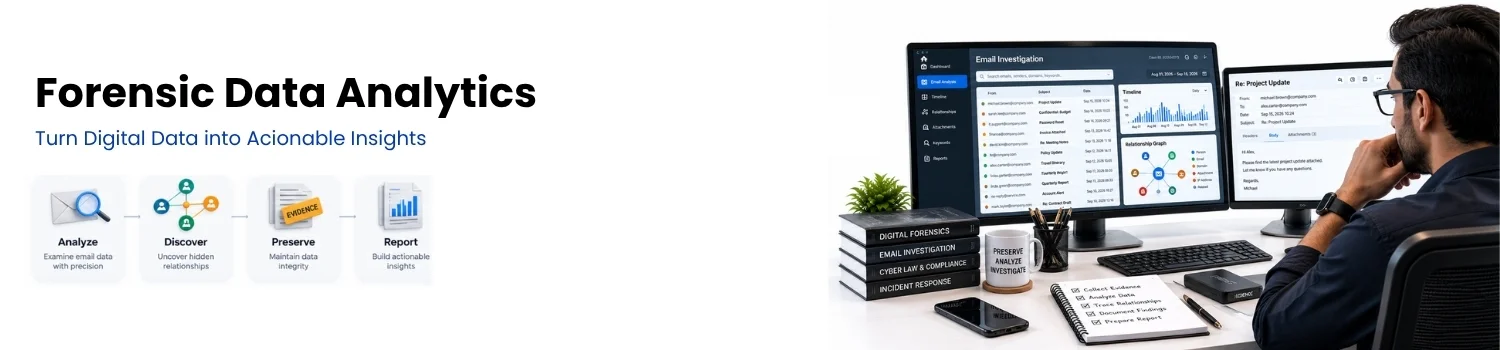
It is not about finding unusual. Real goals is to understand
- What happened,
- When it happened,
- How different parts of evidence relate to each other
- What available evidence can support.
In short: Forensic data analytics converts large and complex datasets into investigation-ready information through finding patterns, connections, anomalies, and evidence that needs closer examination.
Forensic data analysis plays a pivotal role in understanding the who, what, when, where, and how of complex incidents hidden within vast digital data landscapes. This practice uncover hidden and lost email evidence and provides you with a clear picture of how to maintain evidence handling in digital forensics
What Is Forensic Data Analytics
Forensic data analytics is application of analytical methods and processes to data collected for an investigation so important and useful patterns, relationships, and evidence can be identified and examined. Here important word is investigation.
- Traditional data analytics ask, “What is happening in this dataset?”
- Forensic data analytics asks specific question: “What this data tell us about event or behavior being investigated?”
For example, imagine an employee normally sends a small number of emails each day. During one week, the account suddenly sends hundreds of messages containing attachments to external recipients.
That change does not automatically prove wrongdoing. But it creates a pattern worth examining.
An investigator can then correlate the email activity with timestamps, attachments, user activity, other communications, system events, or additional evidence. The goal is to build a clearer picture of what happened rather than treating one unusual event as a conclusion.
| Forensic Data Analytics | Digital Forensics |
|---|---|
| It is to find patterns, relationships, anomalies and relative information within data. | Focuses in identification, collection, preserving, examining and analyzing digital evidence. |
| Can Work with large and varied datasets | Focus on particular devices, systems, media and artifacts. |
| Analysis methods are correlation, filtration, statistical analysis, NLP and visualization | Uses forensics acquisition, examination, artifact analysis, recovery and documentation. |
| Helps investigators decide where important evidence exists. | Helps investigators examine evidence and determine what it can show. |
NIST describes digital forensics as involving:
- Identification
- Collection
- Examination,
- Analysis of digital evidence.
Its guidance also shows four-phase forensic process of collection, examination, analysis, and reporting. In practice, two can work together. Digital forensics provides evidence and forensic process. Forensic data analytics helps investigators in making sense of large or interconnected datasets within that process. That difference matters because analytics should not be presented as replacement for forensic examination. Statistical pattern, machine-learning output, or visualization is clue or analytical result. Its significance still has to be examined in context.
How Forensic Data Analysis Works
Reliable forensic data analysis process begins with preserving evidence and ends with documented findings. NIST’s established forensic model describes four things:
- Collection
- Examination
- Analysis
- Reporting.
Exact details can vary from case to case and data source, but principle is consistent:
- Preserve evidence
- Examine it systematically
- Analyze what was found,
- Document the result.
Forensic Data Analytics Process
Step 1: Acquire and Preserve the Data: First step is to determine which data sources contain relevant evidence and acquiring data using appropriate process. Depending on investigation, that can include emails, documents, databases, operating-system artifacts, network information, application data, or other digital records.
Preservation matters because collecting digital data can affect what is later available for examination.
Proper process requires documentation. SWGDE guidance emphasizes evidence integrity, security, chain-of-custody documentation, hashing, and detailed collection notes.
Step 2: Examine and Prepare Data: Once data has been acquired, investigators need to determine what is present. This involve:
- Parsing files
- Extracting metadata
- Indexing content
- Identifying relevant artifacts,
- Filtering unnecessary information, and preparing datasets for analysis.
This is where large investigations can become difficult. Case can contain thousands and millions of records, and data in different formats. Examination tools and manual review can work together to identify information that deserves deeper analysis.
Step 3: Analyze and Correlate: This is where forensic data analytics becomes extremely useful. Investigators can compare events, identify patterns, correlate records, build timelines, examine relationships, and search for repeated connected behavior. Consider simple example:
- Email containing confidential attachment was sent at 10:14 AM.
- System event occurred at 10:12 AM.
- Second email was sent to an external address at 10:18 AM.
Looking at each record separately tells only small part of the story. Connecting them creates timeline that can guide investigation. NIST notes that bringing together data from multiple sources can provide more comprehensive view of what occurred.
Step 4: Report Findings: Final stage is explaining what analysis found and how findings were produced.
Good forensic report should not simply say, “System found suspicious activity.” It should explain Relevant evidence,
- Methods used,
- Important findings,
- Limitations,
- Where appropriate, alternative explanations.
NIST specifically notes that when more than one plausible explanation exists, alternatives should be considered rather than presenting unsupported definitive conclusion. SWGDE recommends documenting analytical techniques so that another appropriately trained professional can understand and repeat the process.
Key Techniques in Forensic Data Analysis
At the heart of forensic data analytics is the ability to take a massive amount of structured and unstructured data and turn it into meaningful evidence. Something that points to risk, fraud, or regulatory gaps. But now the question is, how exactly is this done?
Let’s break down the key techniques that form the foundation of any solid FDA approach.
1. Data Collection and Normalization
Before analysis of forensic data, data needs to be collected from various sources like financial systems, emails, access logs, or third-party databases. But the raw data is of no use until it’s cleaned, formatted, and structured. Here comes the term data modeling. Analysts create consistent formats, remove noise, and prepare the data for deeper exploration.
2. Predictive Analytics and Machine Learning
Here’s where things get smarter. Machine learning in forensics enables systems to learn from historical data, spotting trends and forecasting future fraud risks. It’s not just about spotting what’s already happened; it’s about predicting what might happen next. That’s a powerful shift in fraud detection strategy.
3. Text Analysis and NLP
Modern forensic investigations rely heavily on Natural Language Processing (NLP) to make sense of unstructured data like emails, messages, and reports. With text analysis for fraud detection, you can search index language patterns or sentiment shifts that often precede unethical actions.
4. Visualization and Reporting
The findings must be communicated effectively once patterns are detected. Dashboards, heat maps, and interactive analysis help examiners quickly grasp what’s happening and why, making compliance monitoring more transparent and actionable.
What are the Common Challenges an Investigator Faces in Forensic Data Analysis?
Although forensic analytics of data is a powerful technique, implementing it isn’t smooth sailing. It also comes up with its share of roadblocks, especially when dealing with sensitive information. Legacy systems or diverse formats.
Understanding these challenges is the first step toward overcoming them.
Data Quality and Integrity
The foundation of Forensic data analytics is good data. But what if your source data is incomplete, inconsistent, or poorly documented? That’s a real issue. Low-quality data leads to inaccurate analysis and unreliable insights, the exact opposite of what you’re aiming for in fraud investigation or compliance monitoring.
For example, when analysts attempt to search for evidence within Emails, any gaps in metadata, corrupted headers, or missing attachments can skew the investigation results or even hide crucial findings. That’s why maintaining data integrity from the beginning is critical to ensuring dependable outcomes in forensic investigations.
Data needs to be validated, cleaned, and standardized before it can offer any value. This stage is often the most time-consuming, but it’s critical.
Integration with Legacy Systems
Today also many organizations still run outdated infrastructure like ESP systems from the early 2000s or siloed databases. Integrating these legacy systems with modern data analytics tools can be technically challenging and resource-intensive. That’s why smart planning and phased rollouts are essential for successful deployment.
Privacy and Legal Constraints
When you’re analyzing sensitive data, especially in cross-border investigations, privacy laws come into play. GDPR, HIPAA, and other frameworks limit what data can be accessed, how it’s stored, and who can see it. Non-compliance here can lead to massive fines.
That’s why data governance and secure access controls are essential components of any forensic analytics environment.
Overcoming these challenges requires both strategic planning and cross-functional collaboration. But once addressed, the forensic data analytics can operate as a seamless, scalable engine for insight and protection.
Simplified Forensic Data Analytics Process in the Simplest Way
When it comes to Forensic Data Analysis, email remains one of the richest and most exploited sources of evidence. Whether you’re investigating any digital violations, email analysis is critical. So here comes the need for the best email forensic solution globally. MailXaminer is a complete software that is used for deep analysis of forensic data in a more advanced and authentic way.
This remarkable software offers different analytics options that help investigating officers to examine the emails deeply. Each option is distinct, which provides information associated with the suspected email message.
The screenshot below will show you all the forensic data analysis options that the software provides you:
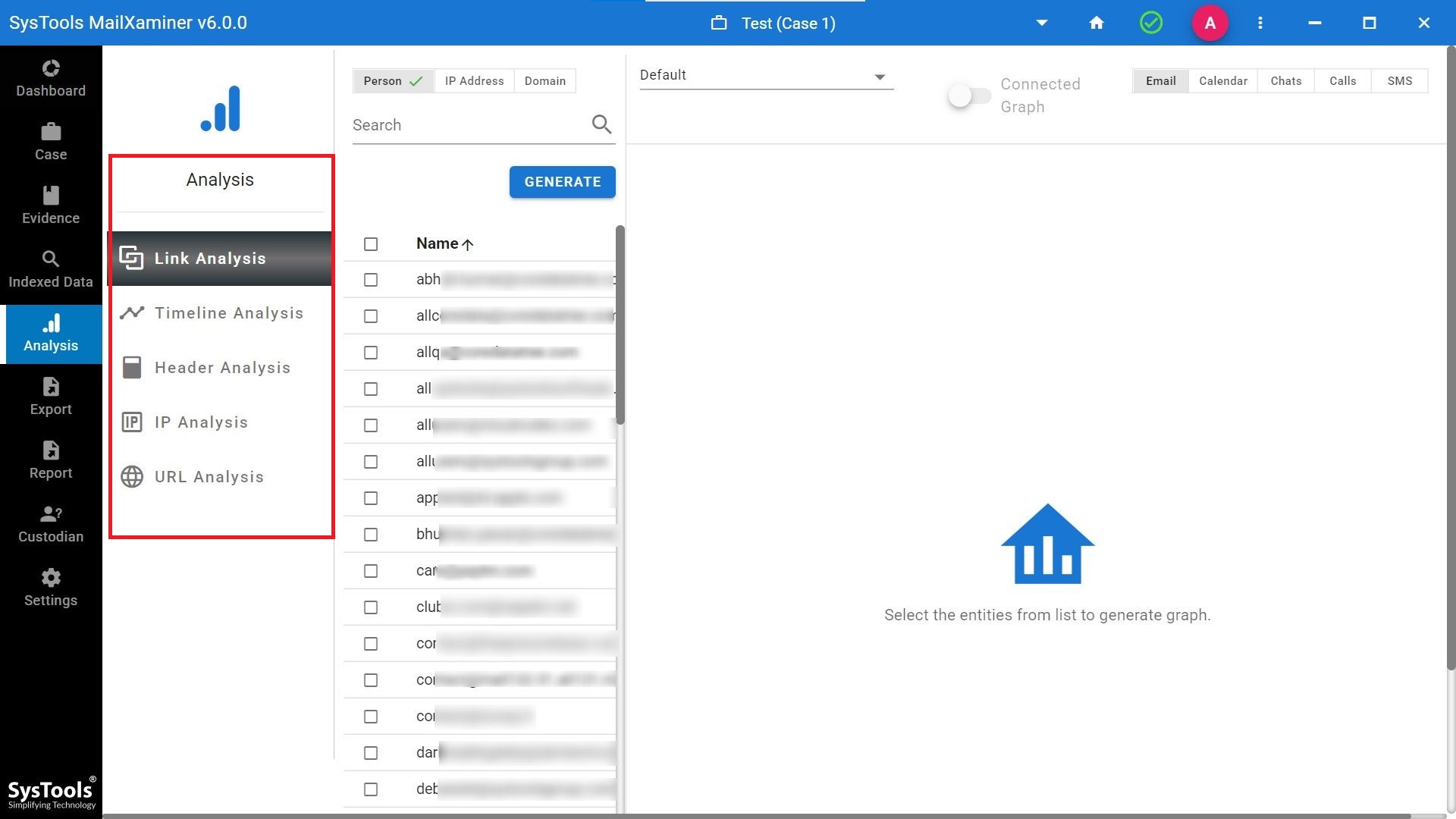
Let’s discuss the functionality of each analytics option in detail:
Advanced Features of the Software
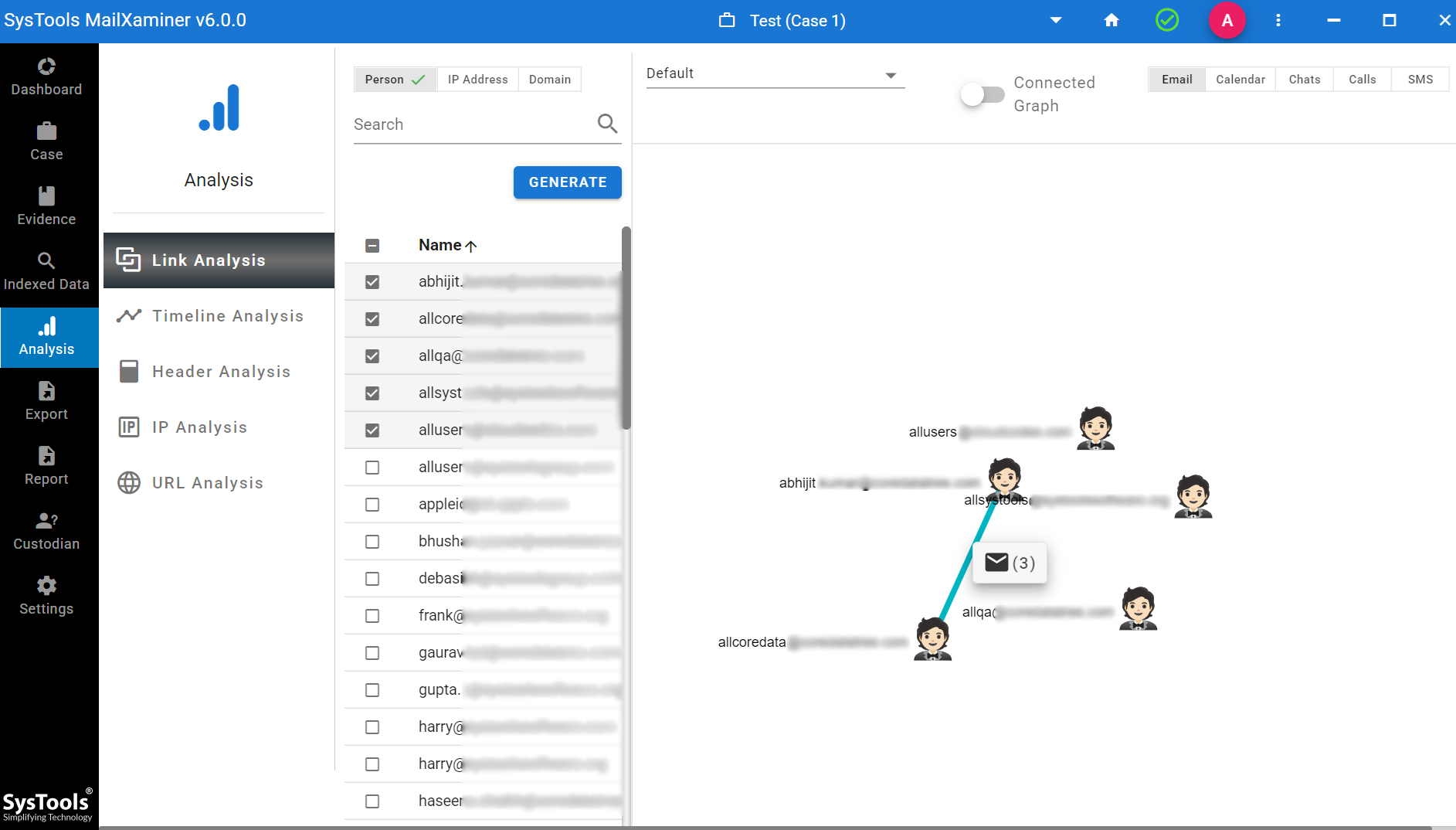
- This advanced forensic software is designed for the deep analysis of emails as evidence. It consists of features for link analysis. One can efficiently detect the relationship between multiple users who are connected. Once the email addresses are selected, it shows a pictorial representation with Mail, Chat details through which they are linked with each other. The date filter option is also available to analyze the specific data within the provided date range.
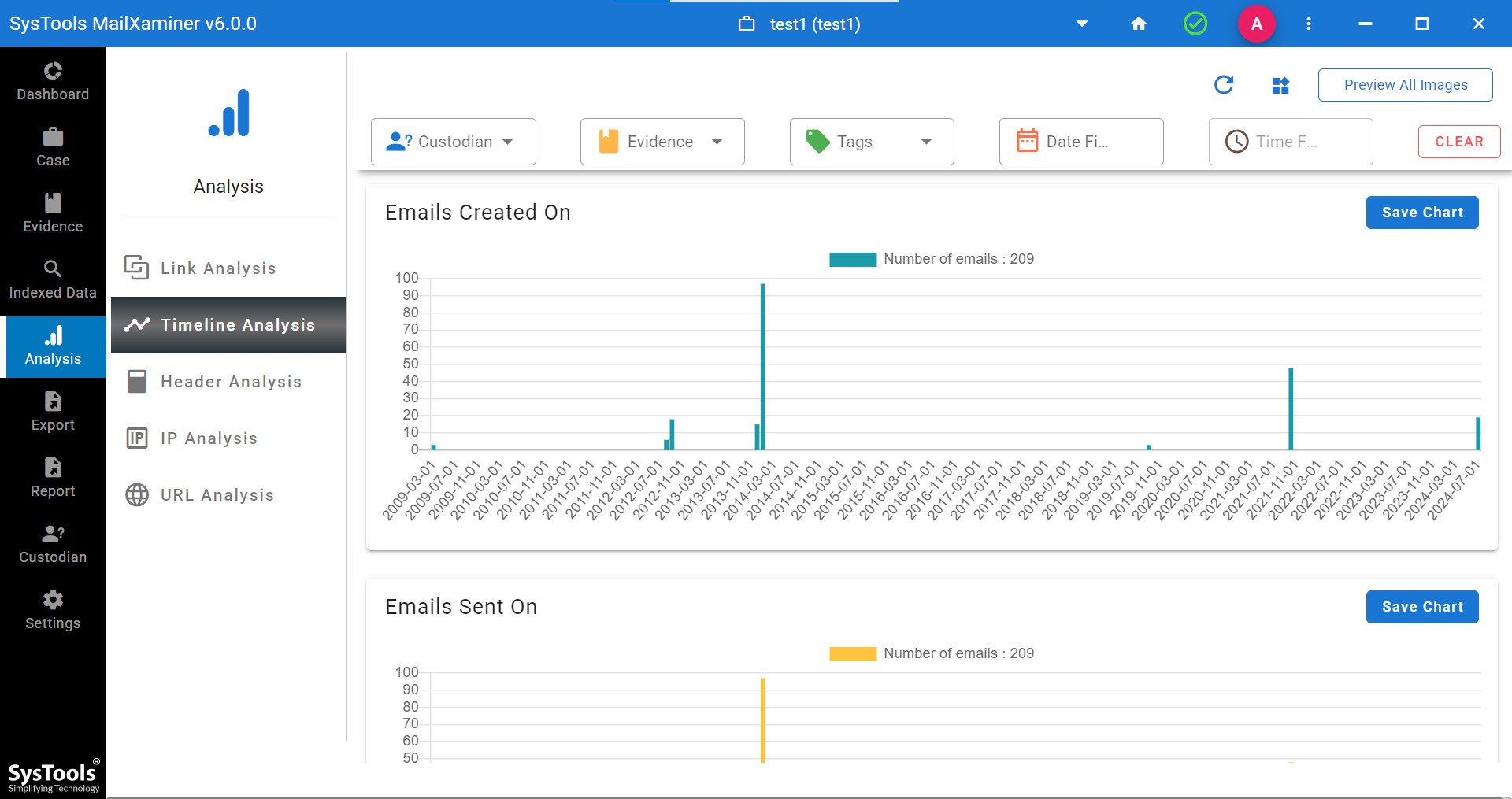
- Timeline Analysis provides a graphical representation of the frequency of emails by Year, Month, and Date. It helps the investigator to view a detailed email conversation between the sender and the receiver. Besides this, it also provides information about the type of data that has been extracted from the email message. This includes Mails, Deleted Emails, Attachments, Calendars, Loose files, Chats, Calls, SMS, etc.
- For complete forensic data analysis, this software allows the advanced email header analysis feature. Through this feature you will be able to analyze the email evidence through email metadata.
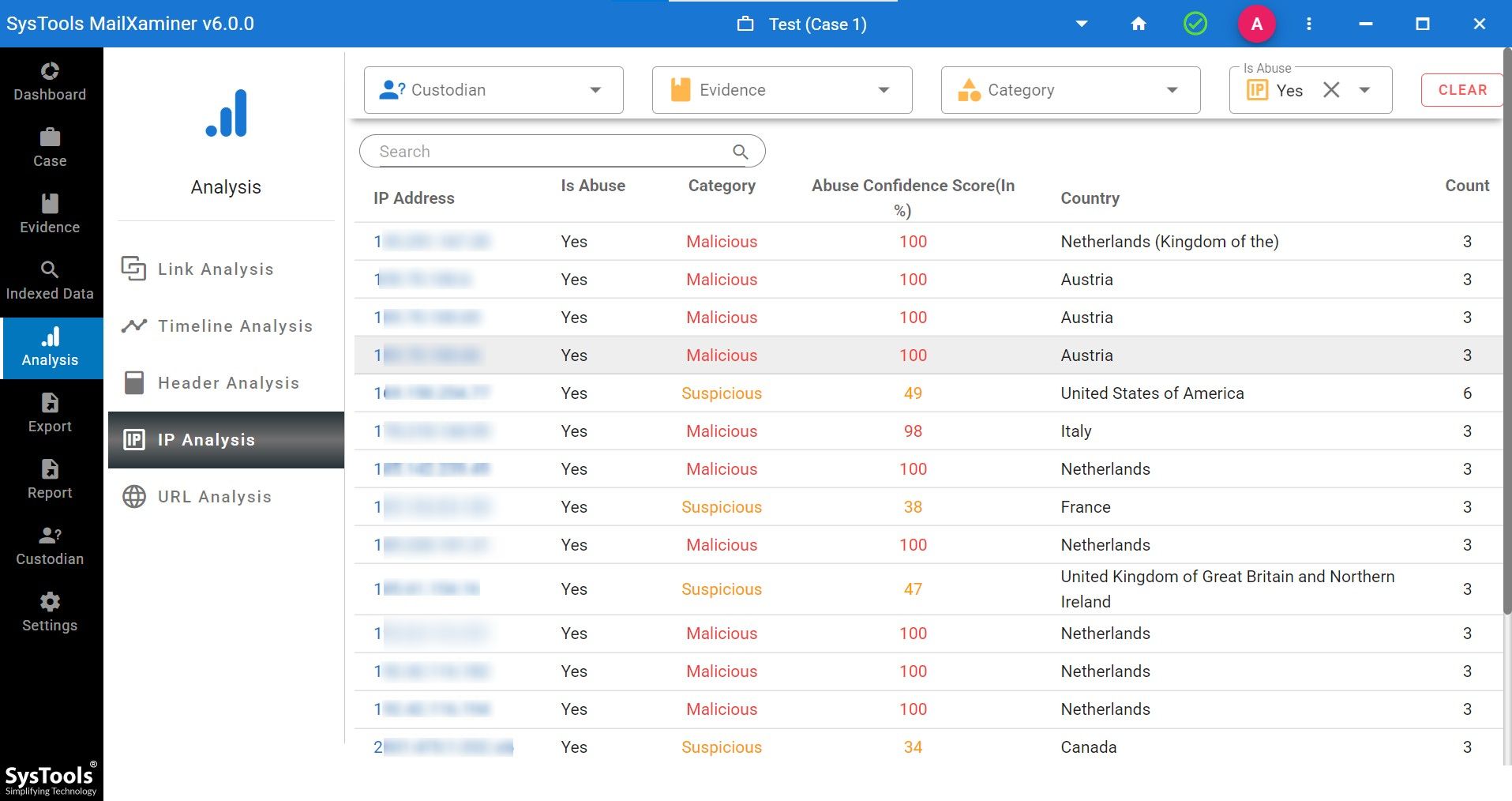
- One other feature of IP analysis allows users to see the complete result of detected IP addresses. This feature will show a thorough report of whether is selected email IP is abused or not, what the spam score is, the country, and several counts.
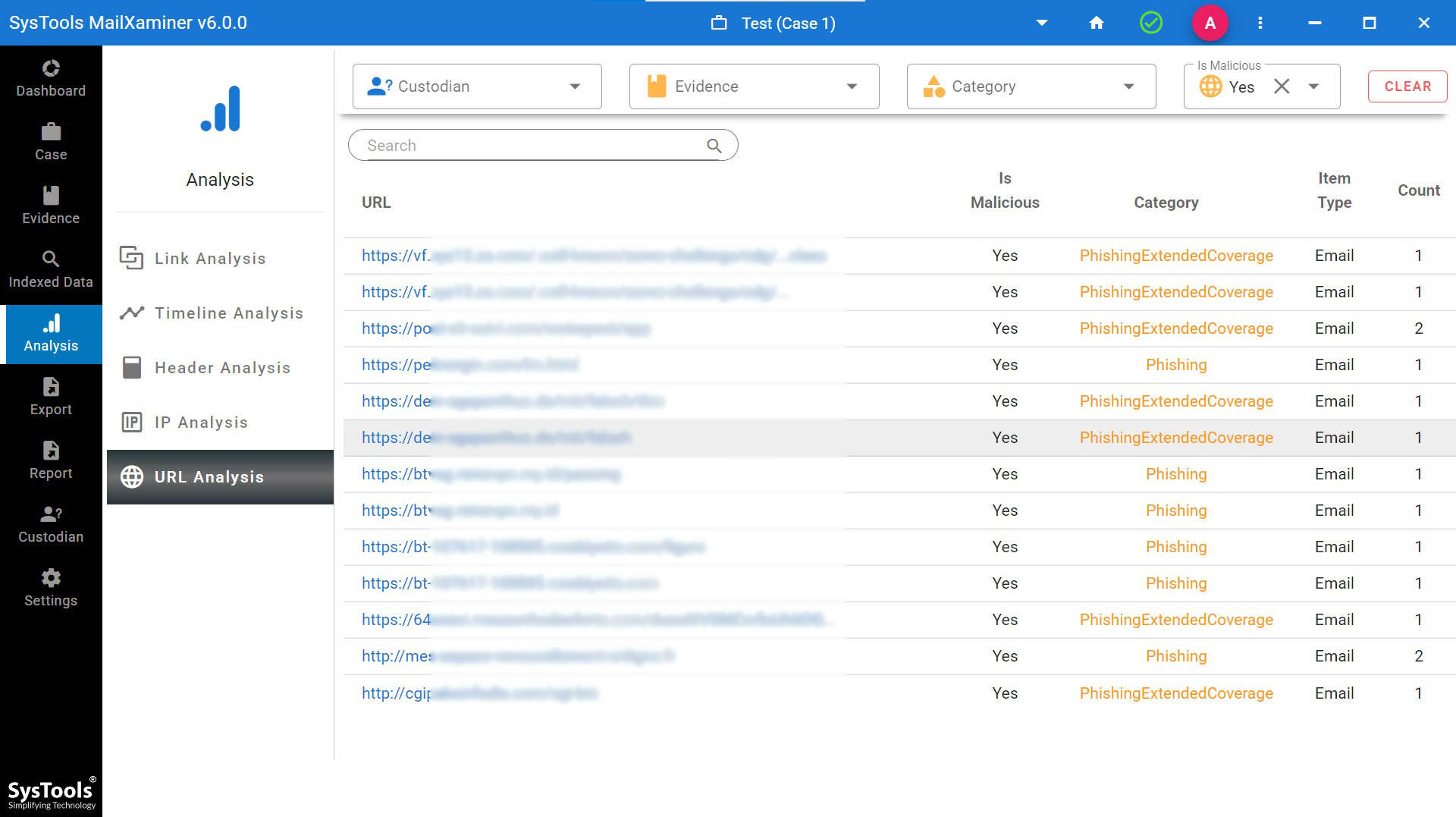
- This advanced tool is designed in such a way that it can analyze URL for malware as well.
Frequently Asked Questions
Q: What is forensic data analytics ?
A: Forensic data analytics examines data related to investigation to find patterns, anomalies, relationships, and evidence that help answer investigation question.
Q: How forensic data analytics work ?
A: It follows four stages: data collection, examination, analysis, and reporting, while maintaining evidence integrity and proper documentation.
Q: What techniques are used in forensic data analytics ?
A: Common techniques include filtering, anomaly detection, pattern recognition, timeline analysis, link analysis, NLP, data visualization, and machine learning.
Q: How is AI used in forensic data analytics ?
A: AI can help identify patterns, classify data, prioritize evidence, and analyze large datasets, but findings still require human validation and forensic judgment.