What is Digital Footprint & Why It Matters


“On your laptop you searched for party shoes last Tuesday, on Wednesday, every website you visit will be showing you shoe ads. No one asked you and told you. But someone was watching, and they remembered.”
That is how digital footprint work. Every search you make, email you send, website you visit, all leaves a trace. What is digital footprint exactly? It is the sum and combination of everything you have ever done online. It reveals more than most people realize.
For cybersecurity professionals, investigators, students and those who authenticate emails for evidence, understanding digital footprints is essential.
What Exactly is a Digital Footprint?
Digital footprint – Sometimes called a digital shadow or electronic footprint. It is a unique trail of data a person or an organization creates when using the internet. It includes:
- Every website visited
- Email sent
- Every form submitted online.
Think of it like this
Think of walking on fresh snow on a winter morning. Every step leaves a perfect print behind you. You reach your destination and never look back. But behind you, a complete detailed map of everywhere you went, how fast you walked and exactly where you stopped. That snow is an internet you always leave a print on.
In cybersecurity and digital forensics context, digital footprint is not just a privacy concern; it is logbook. Once that book records IP addresses, timestamps, metadata and behavioral patterns. For investigators that logbook is evidence.
Active vs passive – Two Faces of Your Digital Footprint
Not all digital footprints are created same way. There are two fundamental types, and understanding the difference is needed as it changes how you think about your online presence.
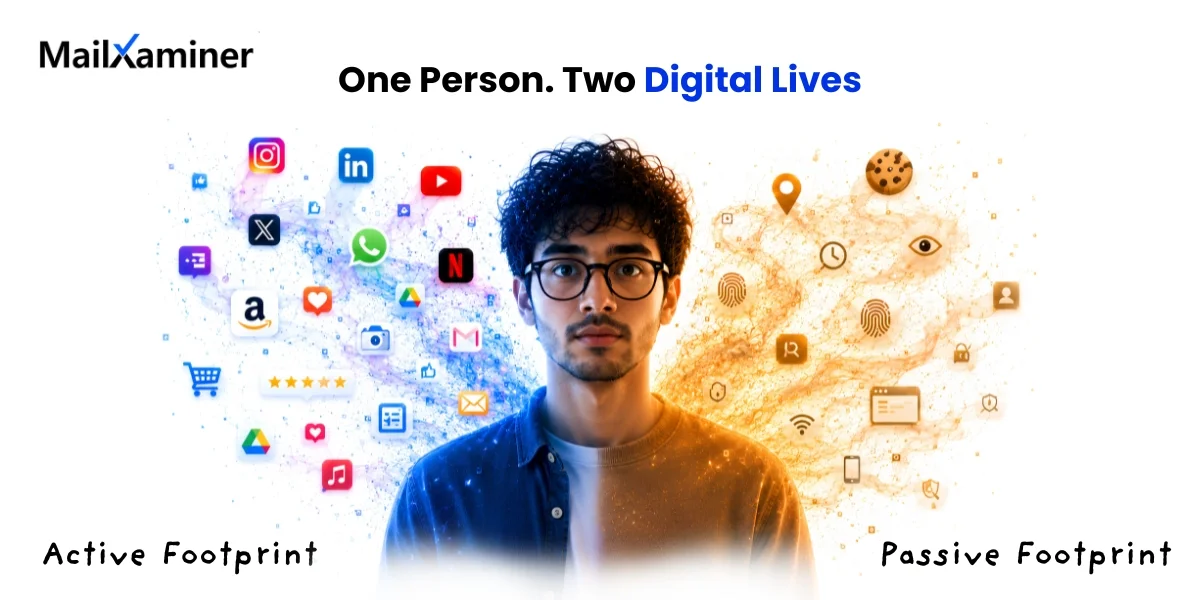
There are private footprints also. That contains data shared only within closed groups and commercial footprints, created when you shop, bank or subscribe anything online. Together, these four types build a comprehensive picture of who you are in the digital world.
Real-Life Examples of Digital Footprints
We hope you are getting some clarity on what is digital footprint. Digital footprint is not one thing. It is thousands of tiny data points accumulated over years. Here are most common ones and what each one reveals about you.
It contains IP addresses, device info, timestamp and location data. Even if you delete it from your inbox. Forensic investigators read this data like a map. |
||
Your name, address, card pattern and buying behavior. Gets stored, analyzed and sometimes sold to data brokers without you even knowing. |
||
GPS location, microphone access, contact list and usage time are recorded in background around the clock, whether you are using app or not. Note – Keep apps that you use regularly and delete those that are not used. |
||
Query text, search time, device used and your location. Search engines build a complete behavioral persona from your history. Even private mode is not fully private. |
||
Every like, share, comment and follow creates a public record of your opinions, interests and associations. Visible to employers, governments and advertisers. |
||
Uploading or editing files on Google Drive or OneDrive creates timestamps, device logs and user IDs, detailed record of what you worked on and when. |
Why your digital footprint matters more than you think
77% of employers: Google job applicants before the first interview. Your digital footprint is your first impression, and you did not select what it says about you.
Beyond employment, digital footprints influence national security decisions, corporate espionage investigations and legal outcomes. In cyber-forensics, the invisible marks, we leave online often leads to identity attribution, insider threat detection and case resolution.
Single email header, most people never think about. It can reveal a sender’s physical location, device, and the exact moment a message was composed. Through Email header analyzer.
Video by The Digital Classroom Experience | Embedded for educational reference only.
Is your digital footprint permanent?
Yes, it is and here is why that should change how you behave online, starting today.
Think of it like this
Imagine you took a screenshot of a tweet (X Post), the moment it is posted, before that person detects it. The internet do this automatically for everything without asking your permission. Cached pages, archived snapshots and third-party databases. Your data lives in the places you have never visited and cannot reach.
How to Check Your Digital Footprint

- Google yourself thoroughly – Search your full name, username and common variations. Look ahead page one and result on page 3 matter too.
- Run an image search – Your pictures reveal more than text/ Use reverse image search to find where your pictures appear.
- Check data aggregator sites – Sites like Spokeo or BeenVerified compile public records. What they show is what anyone can find.
- Set up Google Alerts for your name – Through this you can get notifies the moment your name appears new on internet. This method is Free, instant and essential.
- Audit your social media privacy – Keep a check on every platform. What you think is private and what actually is are not the same thing.
How to Protect Your Digital Footprint
- Audit app permissions every 3 months – Is your flashlight app need access to your contacts? If answer feels wrong, it probably is.
- Use a VPN on public networks – VPN masks your IP addresses and encrypts your traffic. We can think of it as a tinted window on a car. People can see you are there, but not who you are.
- Delete dormant accounts – Old accounts you forget about are unlocked doors. One should close them before someone else walks in.
- Think before you post permanently – Public content is permanent content. If you do not want is screenshotted and shared. Do not post it.
Digital Footprints in Cybersecurity Investigations
For many people, digital footprint is a privacy concern. For cybersecurity investigators, it is evidence. Every email header, IP address, timestamp and piece of metadata is a part of story of what happened. Digital footprints are how that story gets resolved.
Think of it like this
Forensic investigator walking into a crime scene don’t see a messy room. They see a story narrated through fingerprints, footprints and physical traces. Digital forensic investigators do the same thing; their crime scene is an inbox. Every email header, metadata tag and routing path is a clue. Digital footprints rarely lie.
Whenever any digital investigation takes place, analysis of digital footprint become the foundation of the entire case. IP addresses establish location, Timestamps establish sequence and Routing headers establish identity. Together, they build something no alibi can defeat.
Wrapping Up
Your digital footprint is already out there; what you do next is what matters. You know what is digital footprint, how it is created, who sees it and why it matters. Both for personal privacy and for cybersecurity investigations. The trail you leave online is not something to fear. It is something to understand, manage and when necessary, forensically analyze. Every click tells a story. Make sure yours is one you have thought about.
Frequently Asked Questions
Q.What is digital footprint easy definition?
A – Digital footprint is the collection of data a person creates while using internet. Including websites visited, social media activity, emails sent and online purchased. It is your unique online identity trail.
Q. How can one erase digital footprint?
A – Not completely, you can reduce it by deleting accounts, requesting data removal and limiting what you share. But cached pages, third-party databases and archived data make full erasure practically impossible.
Q.What are five examples of digital footprints?
A – 1. Emails sent and received. 2. Social media posts and likes. 3. Online shopping history. 4. Search engine queries. 5. Location data recorded by mobile apps.
Q.Who all can see my digital footprint?
A – Employers, advertisers, governments, universities, hackers and cybersecurity investigators can all access parts of your digital footprint, depending on how public or private your online activity has been.