How to Manage Organizational Communication: Practical Guide to Clearer, Smarter Workplaces


Quick Answer: How to manage organizational communication is a must ask, question for every business because our work depends on information moving to right people at the right time.
- Missed update.
- Unclear instruction
- Message sent via wrong channel or mode
Can slow your team down, create confusion, and make an important decision harder to trace later. Think about normal workday. Manager sends an email. Team then discusses same agenda on chat. Someone mentions it in meeting. Decision is made, but no one writes it down.
Work may continue.
The problem appears later.
- Who knew what?
- When did they know it?
- What was decided a
- Which message was the final one?
Effective organizational communication answers those questions before they convert into a problem.
Note: Goal is not to communicate more. But to communicate clearly, deliberately, and with enough context for people to act upon.
What Is Organizational Communication?
Organizational communication is a process through which information moves between people and groups inside and outside a business. It includes:
- Instructions from managers.
- Updates among coworkers.
- Feedback from employees.
- Customer communication
- Meeting discussions.
- documents, email, messaging.
- Other workplace interactions.
It is much more than an act of sending messages. Effective organizational communication helps people understand: what is happening, what needs to be done next, who is responsible, and why work matters. That is the reason why communication is connected to coordination, decision-making, employee relationships, customer service, and accountability.

What Organizational Communication Management Include?
Organizational communication management means planning how information is created, shared, received, documented, and improved inside an organization. Solid organizational communication management approach answers five simple questions:
| Question | What it helps define |
|---|---|
| What | Information that needs to be communicated. |
| Who | People who need to receive and act on it. |
| When | Right time to communicate |
| Where | Most suitable communication channel |
| How | Format, tone, context and level of detail. |
Our aim is not to control every conversation. It is to create a solid structure that important information should not get lost and everyday communication shall also remain safe.
Related Read: Find Attachments in Outlook Email Chain
Why Organizational Communication is Important
Organizational communication matters because people cannot manage and complete work efficiently without information. Team can contain excellent employees and strong and sophisticated technology, but unclear communication can cause:
- Duplicated work
- Missed deadlines
- Wrong assumptions
- Delayed decisions.
Miscommunication also affects trust. When employees know where to find information, who makes decisions, and how feedback is handled, Workplace becomes easier to navigate.
When information is inconsistent or hidden across too many channels, people spend time trying to interpret organization instead of doing their work.
In simple terms:
- Clear communication reduces confusion.
- Timely communication supports faster decisions.
- Two-way communication helps surface problems.
- Communication that is documented can improve accountability.
- Consistency in communication helps people work toward the same goal.
Main Types of Organizational Communication
Main types of organizational communication describe where information moves and who is involved.
- Internal communication: This happens within an organization. It includes communication between employees, teams, managers, and leadership.
- External communication: It is between the organization and outside groups such as customers, suppliers, partners, regulators, or public.
- Formal communication: This follows proper business structures, such as policies, official announcements, reports, approvals, and documented instructions.
- Informal communication: This type of communication is developed through everyday interactions, such as conversations, quick messages, informal discussions, and social workplace exchanges.
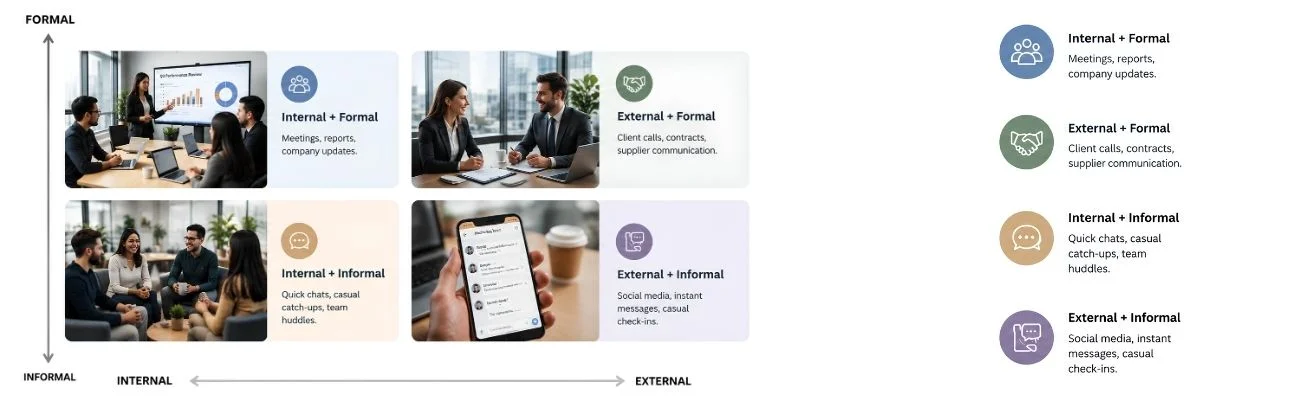
Categories can overlap. Email from manager to an employee may be internal, formal, and downward communication at same time.
Related Read: How to trace an email address to its owner
Which Communication Channels Should Organizations Use?
There is no single best communication channel for every message. Right channel depends on urgency, complexity, sensitivity, audience, and if message needs a lasting record. This is how to manage organizational communication.
| Channel | Best for | Watch out for |
|---|---|---|
| Formal updates, approvals, documents and detailed instructions. | Long threads and inbox overload. | |
| Chat | Quick Questions and fast coordination. | Important context can disappear in scroll based conversations. |
| Meeting | Complex discussions, disagreement, decisions requiring interaction. | Decisions may remain undocumented. |
| Phone/Voice | Urgent and sensitive conversations | Limited written record. |
| Document | Policies procedures and detailed information. | Version-control problems. |
| Collaboration platform | Shared work, project communication, files. | Information can become fragmented across tools. |
Rule: Use simplest channel that can move message clearly, but use more formal or persistent channel when message needs context, approval, and reliable record.
2026 study of digital communication in hybrid professional services found that digital communication remains central to workplace interaction, while some situations benefit from face-to-face communication.
How Organizational Communication Management Improve Daily Working
Management of organizational communication improves daily working by making information easier to find, understand, and follow up. Useful communication system do not require employees to guess:
- Which channel should I use.
- Who needs this.
- Is it urgent.
- Does someone need to approve it.
- Should I document this decision.
Instead, the organization establishes clear expectations. For example, team in a company:
- Use chat for quick coordination,
- Email for formal decisions
- Meetings for complex discussions.
- Shared documents for information that needs updating.
This does not remove human judgment. It gives team members common starting point.
Related Read: How to trace email address to its owner
How Organizations Manage Digital Communication Overload?
In today’s business world management of organizational communication is a complex task. When digital communication becomes difficult to manage because volume of messages grows faster than people’s ability to process them. June 2026 study analyzed more than 1.4 million emails involving 1,149 employees and found that email connectivity can have both positive and negative relationships with work outcomes. This reinforces the need to balance connectivity with communication volume.
Practical lesson is not “send fewer emails” in every situation. It is: Make communication channel carry a clear purpose. Organizations can reduce overload via:
- Limiting unnecessary notifications.
- Using clear subject lines.
- Avoiding duplicate messages
- Setting expectations for response times
- Moving recurring information into organized shared resources.
Goal is not silence. It is signal over noise. This is how to manage organizational communication in today’s digital business universe.
What Role AI Play in Modern Organizational Communication?
AI is becoming an inseparable part of organizational communication through:
- Writing assistance
- Translation
- Summarization
- Chat systems
- Meeting support
- Customer communication
- AI-generated content.
This creates useful opportunities, but it also changes how organizations think about trust and communication norms. 2026 study of AI-mediated organizational communication identifies growing research around AI-assisted communication, human-AI interaction, and governance in AI-enabled communication environments.
Another study shows that AI-assisted workplace communication can improve efficiency while raising questions about authenticity, trust, and the role of human judgment.
Let AI help with communication. Do not let it replace responsibility for communication.
Important messages still need human review, appropriate context, and clear accountability.
When Organizational Communication Needs to be Investigated
Organizational communication have to be investigated when messages help an organization understand an event, decision, allegation, dispute, or suspected policy violation.
Examples are:
- Employee misconduct concerns.
- Fraud allegations.
- Data leakage.
- Harassment complaints.
- Intellectual property disputes.
- Insider-threat investigations.
- Conflicts about business decisions.
Important point is that communication is not automatically proof of wrongdoing.
Investigators may need to understand the surrounding context, related email messages, participants, dates, attachments, and other evidence before reaching a conclusion. That is why well-managed and organized organizational communication records can become important when organization needs to understand what happened.
This is where a dedicated email forensics software helps. MailXaminer is designed for examining email data when communication records become relevant to a workplace, digital, or forensic investigation.
Wrapping Up
The article’s main lesson remains the same: manage communication well before problems arise, and know how to examine communication when an investigation requires it.
You made it to the end. Here is an idea worth carrying forward: Good organizational communication is not only sending more messages. It is about making important information clear, timely, useful, and accountable.
- When communication is managed well, people know what to do.
- When it is documented well, organizations can understand what happened.
- And when something serious does happen, communication trail may become one of the places investigators look for answers.
Frequently Asked Questions
Q – What is organizational communication ?
A – It is a process through which information moves between people and groups within and outside business. It includes emails, meetings. Reports, instructions, feedback and other form of workplace communication.
Q – How an organization can improve its communication ?
A – Organization can improve communication through opting for a right channel for each message, using clear language, defining communication responsibilities, encouraging feedback, documenting important decisions, and regularly reviewing where information gets delayed or lost.
Q – Why is email important in organizational communication ?
A – Email is used for formal workplace communication, detailed instructions, approvals, document sharing. Email can create digital records this can become important when an organization needs to investigate dispute, incident or suspected policy violation.