What Is Email Monitoring? Clear and Complete Explanation


Blog Overview – Imagine, you leave your front door unlocked every single day and never check even once who walked in. That is what running a business without email monitoring is like. Every day, hundreds of emails move in and out of your company which carry
- Client data,
- Passwords, Contracts,
- Secrets.
What is email monitoring? In simple terms, it is the practice of watching, scanning, and reviewing that email traffic to catch problems before they catch you. It sounds technical. It is not. Stick with us for your next five minutes, and we will make you understand it better than most IT managers do.
What Is Email Monitoring Means?
You can think of email monitoring like a smoke detector of your inbox. A smoke detector do not stop you from cooking. It just watches, and only makes noise when something is wrong. Email monitoring works the exact same way.
It scans emails moving through company’s system and flags the ones that look
- Risky,
- Inappropriate
- Suspicious.
Email monitoring is a process of tracking, scanning, and reviewing email communications. Within a company, to detect security risks, enforce policy, and protect sensitive information.
It is used by IT teams, HR departments, security officers, and sometimes lawyers. Each for different reasons. But the goal is always the same: know what’s happening inside your own mailbox before it becomes a problem outside of it.
How Email Monitoring Works?
This part surprises people: It is not someone sitting there reading every email you send.
Modern email monitoring runs on autopilot. Software scans messages for specific triggers: Certain keywords
- Sensitive attachments
- Unusual sending patterns
- Contact with unknown domains.
When something crosses that line, it gets flagged for a real person to review.
It works on three simple steps:
- Scan: Every email passing through gets checked automatically.
- Flag: Anything unusual (Huge attachment, banned word, unusual login location) gets pulled aside.
- Review: A concerned person of company looks at the flagged email and decides what happens next.
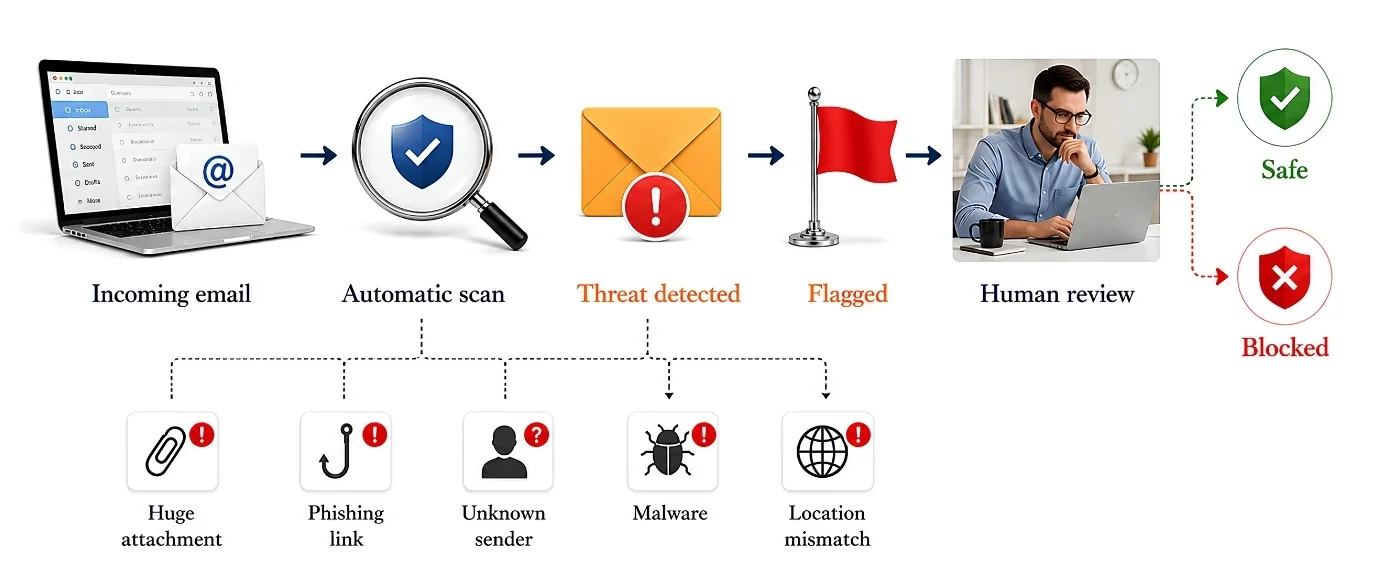
No drama. No spying on your lunch plans. Just a smart filter, working in background.
Related Read – How to see hidden text in email
Four Faces of Email Monitoring
Not all email monitoring wants the same thing. Depending on who is using it, it wears a different hat.
| Type | What It Watches | Its Users |
|---|---|---|
| Security Monitoring | Data leaks, phishing, malware | IT and security teams |
| Employee Monitoring | Productivity, policy compliance | HR and managers |
| Server Monitoring | Delivery speed, uptime | IT operations |
| Investigative Monitoring | Evidence, insider threats, fraud | Legal & forensic investigators |
Many articles and forums online stop at the first three. The fourth one, investigative monitoring, is where things get genuinely interesting, and we will come back to it shortly.
Is Email Monitoring Legal?
Short answer: Yes, mostly, but with one condition.
In US, companies generally have the right to monitor emails sent through their own business systems. The catch is transparency. A written email monitoring policy, shared with employees upfront, is what keeps a company on right side of the law and on the right side of trust too.
No policy, that is when monitoring turns from “smart business” into “lawsuit waiting to happen.”
What to Look for in Email Monitoring Software
If you are shopping for email monitoring software, ignore flashy features for a second. Focus on three things:
- Accuracy: Does it flag real threats, not just false alarms?
- Compliance support: Does it help you stay within your country’s data protection laws, not just watch inboxes?
- Clear reporting: Can a non-technical person actually read the results?
Good software does not just watch. It explains.
When Watching Turns Into Investigating
Here is a story. A mid-sized firm noticed something odd. Their major client, one they had worked with for eight years, suddenly jumped to a competitor. A competitor somehow knew their exact pricing, down to the dollar.
Nobody talked. No files were stolen from any laptop. But somewhere, quietly, information had leaked. This is where regular email monitoring stops being enough and email forensics begins. What a Corporate Espionage Investigation actually needs.
When a leak like this happens, company can’t just “check the inbox.” It needs to reconstruct exactly what happened bit by bit. Even those emails that were deleted, encrypted, or hidden.
That takes specialized email forensics software tools built to:
- Research on hidden emails from company mail servers.
- Analyze metadata to trace exactly who sent what, and when.
- Present findings in a form that holds up legally, in court if needed.
This is not employee monitoring anymore. This is digital detective work.
Where Professional Tools Come
This is exactly the gap most “email monitoring” software does not fill. Everyday monitoring tools are built to watch. Investigation tools like MailXaminer are developed to dig. They analyze and present email evidence from formats like PST, OST, and EDB files, even when someone tried to cover their tracks.
If your business has ever faced a data leak, insider threat, or a corporate espionage scare, and you needed real answers, not just alerts, that’s the exact situation a forensic email tool is developed for.
Frequently Asked Questions
Q – What is email monitoring in simple words?
A – It is a practice of scanning and reviewing emails to catch security risks or policy violations before they cause harm to your company.
Q – Is email monitoring the same as email tracking?
No. Email tracking is used in marketing and checks if someone opened your email to track email opening rate. Email monitoring checks the content and safety of emails moving through a system.
Q – Can email monitoring recover deleted emails?
A – Standard monitoring tools usually can’t. That requires a specialized tool, built specifically for recovery and investigation.