Why Are Mobile Devices Critical to a Digital Forensics Investigation


Blog Overview – Our smartphones knows more about our lives than anything else they own. Mobile devices are critical to a digital forensics investigation because they carry continuous, timestamped record of where someone went, who they talked to, and what they did, all in one place, all the time. This is not an exaggeration. It is just what a phone is built to do. To offer you personalized experience based on your daily activities.
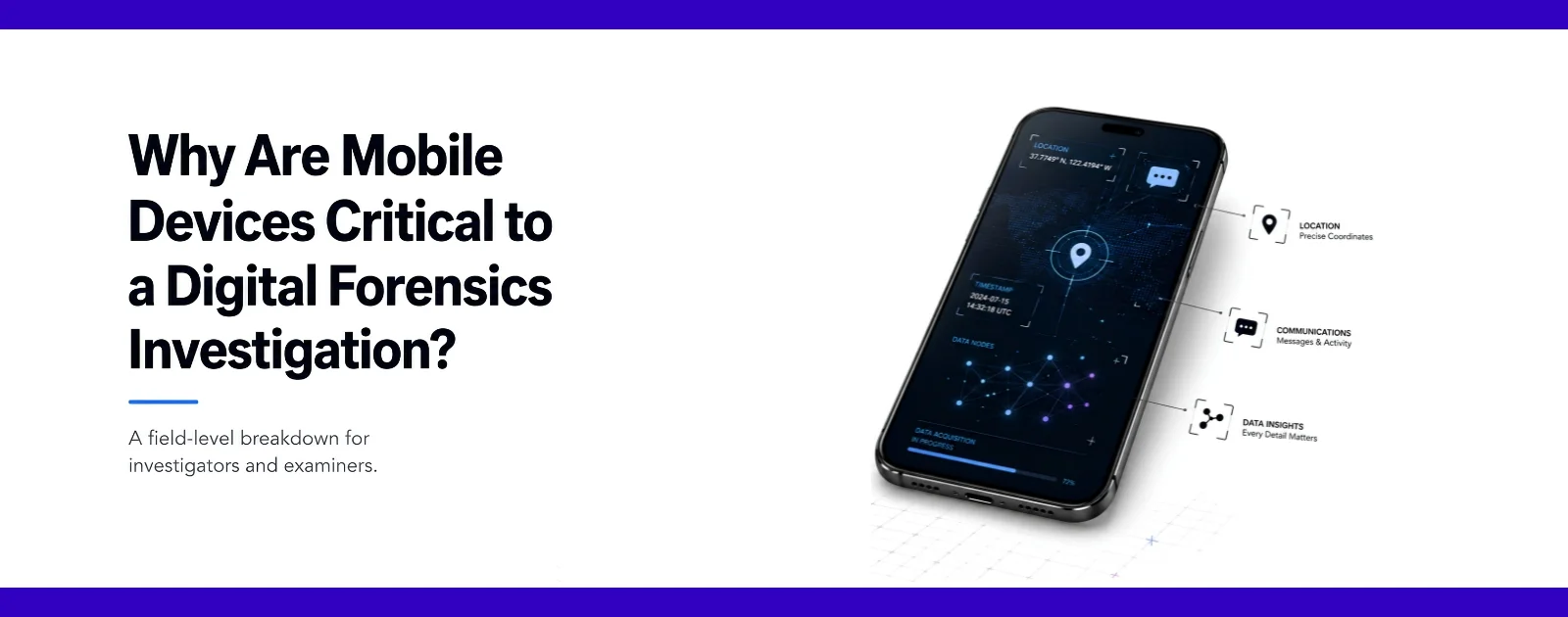
Investigations Now Begin with Mobile Devices
Decades ago, investigations used to begin with desktops and servers. Now the investigations usually start with the mobile phones. As people use smartphones for everything.
- Sending emails on mobile
- Communication through apps.
- Sharing of files.
- Tracking locations.
- Storage of photos and documents.
To give you more clarity, we can think of it like this: mobile devices act as a digital control center of a person’s life. This little rectangle in your pocket records daily actions in real time. For an investigator, this acts as a complete map of a person’s actions.
Related read – Top digital forensic investigation techniques
The Problem: Data Is Available but Hard to Understand
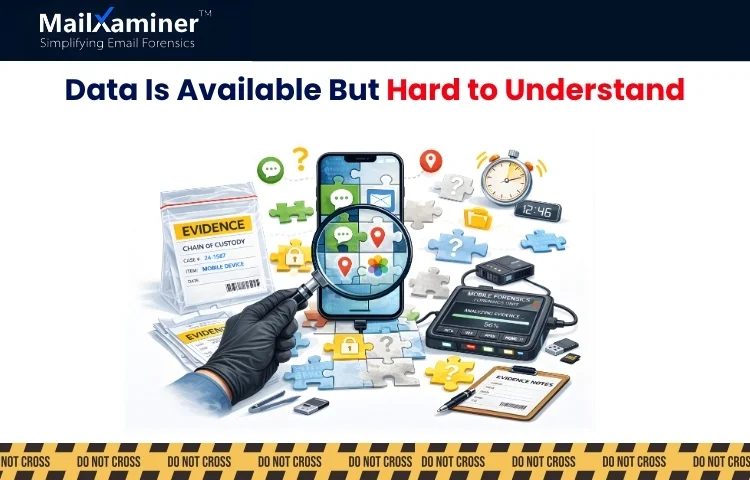
Mobile devices contain valuable evidence that is like gold for an investigator; they are hidden and need to be unwrapped. This is the real challenge investigators face because of too much scattered data.
- Common issues include:
- Data is spread across multiple apps.
- Deleted or hidden information.
- Limited time to analyze everything.
It can be seen as all pieces of a puzzle, but no clear way to assemble them. The data is there, but clarity is missing. To get this clarity, we need to understand why are mobile devices critical to a digital forensics investigation.
What Kind of Evidence Exists in Mobile Devices
Mobile devices hold different types of evidence when combined, tell a complete story:
- Messages (SMS and chat apps)
- Emails (formal communication and attachments)
- Photos and videos
- Call logs
- Location history
Each type of data is important, but when combined. They help investigators understand intent and get closure on the evidence.
Related read – Current challenges in digital forensics investigations
Why Traditional Investigation Methods Fall Short
We have some clarity on why are mobile devices critical to a digital forensics investigation. Still, many investigators rely on traditional methods of investigation, which involve manual work and multiple tools. For instance, an investigator may:
- Extract mobile data using one tool.
- Review emails separately in another system.
- Manually sorting messages, attachments, and logs in spreadsheets.
In some investigations, teams usually rely on basic exports like CSV or PDF files, where one has to scroll through gigantic records just to find one clue. This itself leads to several challenges, like.
- Slow analysis due to manual effort.
- Chances of missing data.
- Difficulty in connecting the evidence across multiple resources,
- Increased dependency on human judgment.
The Missing Link: Data Alone Is Not Enough
The collection of data is only the first step. The real challenge is to convert that data into meaningful insights. Mobile data, app data, and email evidence often exist in separate systems. When these pieces are not connected. We only see the petals rather than a complete picture. To truly understand a case. Data have to be analyzed together, not in fragments.
Making Sense of Complex Mobile Data

Mobile forensic data is large and complex. Without a proper organization and system. It becomes difficult to understand. To make this complexity simple, investigators need to have a professional tool that can help them:
- Focus on evidence.
- Reduction of manual effort.
- Speed up investigations.
Clarity is what turns raw data into usable evidence. To bring this clarity, professional tools help in providing a structured way to analyze evidence. Instead of working with scattered information. Investigators can.
- Analyze communication patterns in one place.
- Understanding the relation between the data points.
- Building clear timelines of events.
Related read – What is timeline analysis in digital forensics
From Complexity to Clarity in Real Cases
We hope you got clarity on why are mobile devices critical to a digital forensics investigation. We can say tool-based approach can be thought of as moving from a cluttered desk to a clean workspace.
| Manual Approach | Professional Tool-Based Approach |
|---|---|
| Data scattered among tools | Highly organized data |
| Difficulty in connecting the evidence | Clear connections between evidence |
| Time-consuming analysis | Faster and more confident decisions |
When we switch to a professional approach, data analysis becomes more predictable. In real-world cases, mobile data that needs to be investigated comes from different forensic tools. This becomes more confusing. This includes data from commonly used tools like MSAB, Oxygen, and UFED. Management of all this data becomes confusing and complex.
This is where tools like MailXaminer allow us to work with all this information in one central place without getting lost in different formats.
Related Read – Current Challenges in Digital Forensics Investigations
Why a Structured Approach Matters

It is said that it takes effort to keep things simple so a structured approach provides simplicity to conduct mobile forensics and extract evidence from messy data simply. This approach,
- Save time
- Reduce errors
- Improve accuracy
- Build stronger cases
A professional approach ensures every piece of evidence is properly researched and analyzed.
Related Read – Admissibility of Tampered Video Evidence in Court
Final Thoughts
Mobile devices are the most critical source of digital evidence today. They contain valuable information that is like gold to an investigator. The real challenge is the extraction and analysis of that data. The traditional approach often fails because they treat data separately. These days, modern investigations require a unified approach where different parts of mobile data can be analyzed together. Through using a structured method and the right tools. Investigators can turn scattered information into a process that can find them evidence which uncovers the truth behind a case.
Frequently Asked Questions
Q – Why are mobile devices important in digital forensics?
A – Mobile devices store messages, emails, location data, and media. When combined together create a complete record of user activity. This makes it a valuable source of digital evidence.
Q – What challenges do investigators face with mobile forensic data?
A – When the question is about mobile forensics, in this domain, investigators deal with scattered data, multiple formats, and large datasets. This makes analysis time-consuming and increases the risk of missing any element when a traditional approach is followed.
Q – How can investigators simplify mobile forensic analysis?
A – Investigators can simplify this using tools that organize and connect data in one place. This process helps in better accuracy and building stronger evidence.
Q – What important parts of a mobile device used in digital forensics?
A: Internal storage, SIM card data, cloud-linked accounts, and app-specific databases are four main sources investigators examine, each holding a different layer of the user’s activity.