Admissibility of Tampered Video Evidence in Court (Detailed Guide)


Imagine, A road accident happens outside a petrol pump in New Delhi. Shop owner’s CCTV caught everything.
- Vehicle,
- Exact moment of impact,
- Number plate.
Crystal clear and Undeniable. But when presented in court, judge rejects the footage. Not because the video lied, but because no-one could prove it hadn’t been touched.
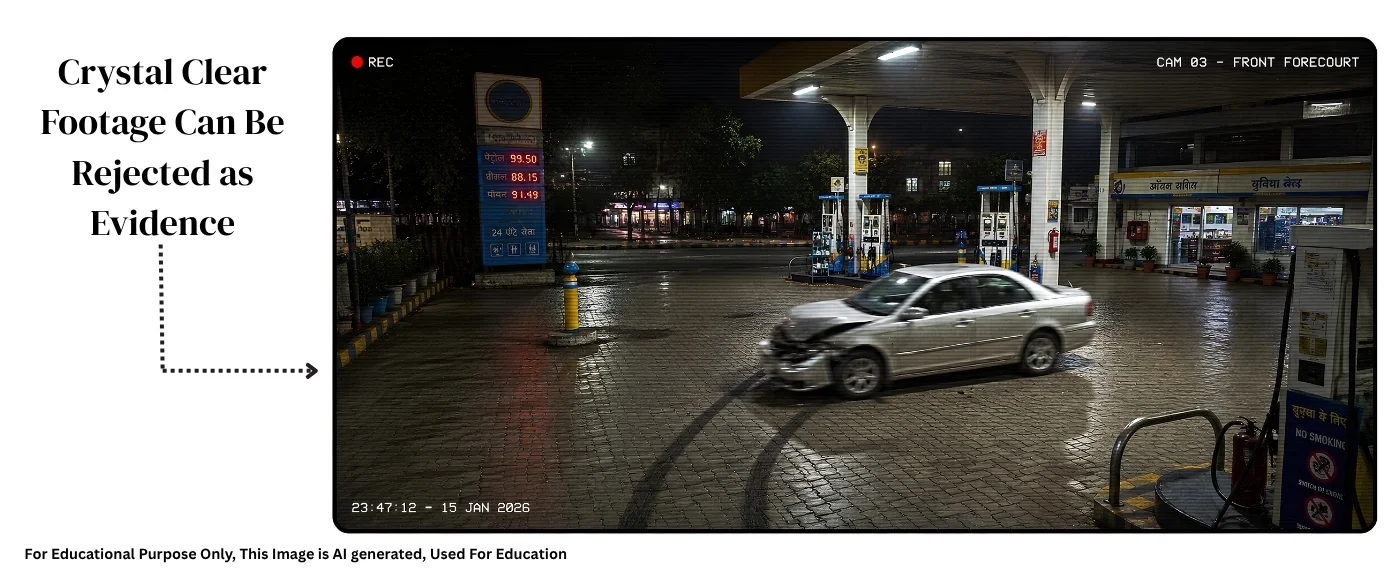
This is the reality of admissibility of tampered video evidence in court. It catches thousands of people off guard every year. Lawyers, business owners, ordinary citizens.
Everyone is holding what they believe is rock-solid proof. All watching it crumble because they don’t know three things:
- What the law demands.
- How courts check video integrity.
- What happens when evidence fails that check.
This blog tells you all three. Clearly. Completely. Without a law degree is required.
Quick Answer: Tampered video evidence is inadmissible in Indian courts. Under Bharatiya Sakshya Adhiniyam (BSA) Section 63, electronic evidence must be authentic, unaltered, and accompanied by a mandatory certificate. If any of these three conditions fail, the video is out.
Tampered video evidence is inadmissible in Indian courts. Under Bharatiya Sakshya Adhiniyam (BSA) Section 63. Electronic evidence must be:
- Authentic
- Unaltered
- Accompanied by mandatory certificate.
If any of the conditions fail the video is out.
Why Most Video Evidence Gets Rejected Before the Trial Even Begins
People believe a clear video equals a strong evidence. They think clearer the footage, the stronger the case. This is a wrong belief and this cost people cases they should have won.
Courts do not just ask what the video shows. They ask whether the video can be trusted or not. Before a single second of video is played in a courtroom, it must clear a legal entry test. Think of this test as a security check at airport. Ticket may be valid, destination may be correct. If you cannot prove who you are, you do not get through.
Law that governs this entry test in India is Bharatiya Sakshya Adhiniyam 2023. It is India’s new evidence law that replaced the old Indian Evidence Act from 1 July 2024
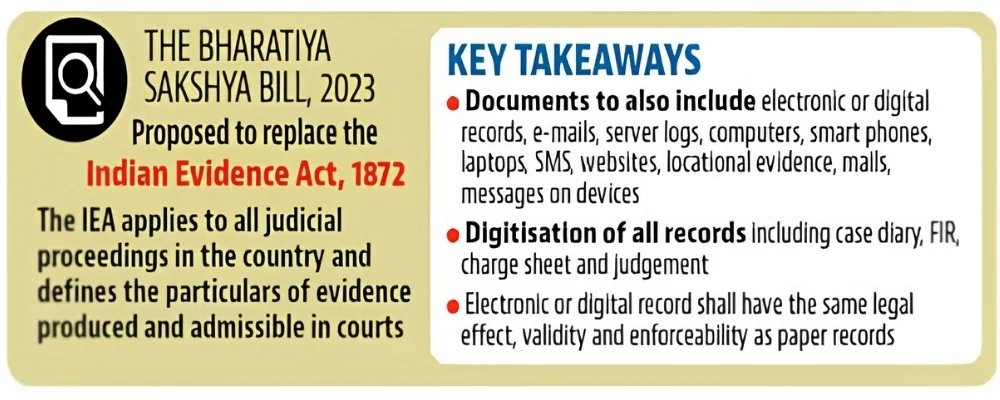
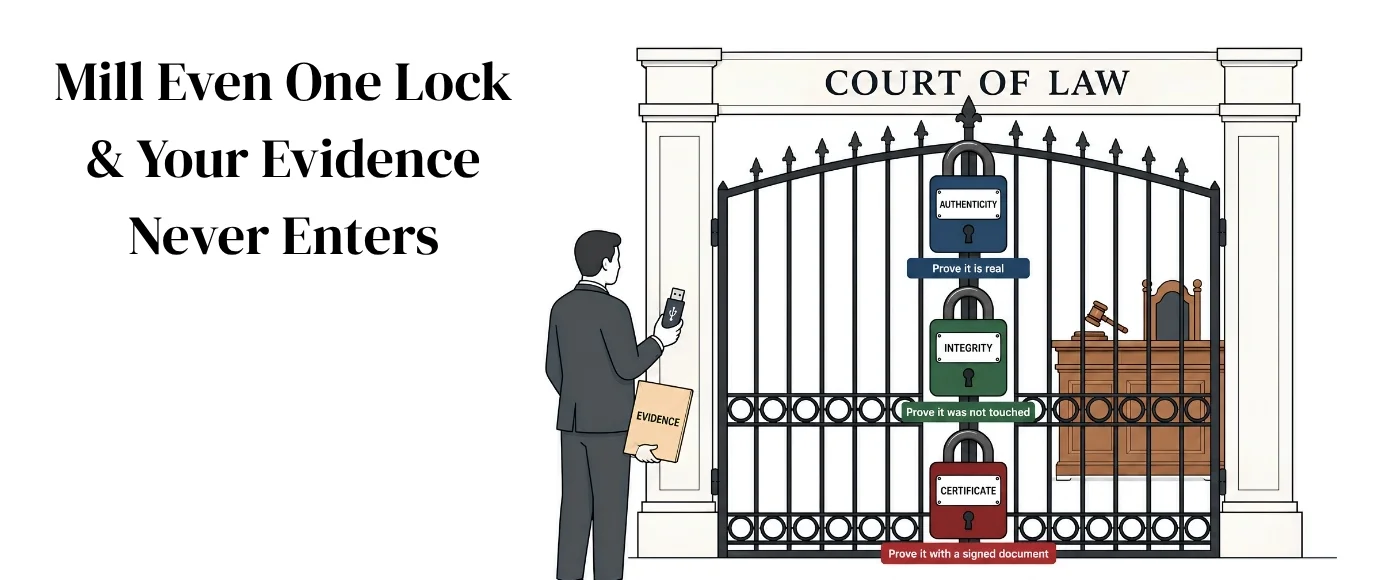
Under BSA Section 63, which replaced the old Section 65B. Every piece of electronic evidence, including video, must satisfy three conditions to be admissible:
- Authenticity – Video must be proven to be exactly what it claims to be. Recorded on the device stated and by the system, stated.
- Integrity – Video must not be altered, edited, spliced or tampered with after the recording. Not even one frame and not even one second of audio.
- Certificate – Signed document which is known as BSA Section 63 Certificate. This must accompany the video. This certificate is just like Registration Certificate of a vehicle. The vehicle can be real, but without RC, no authority will accept it as yours. To see how this certificate looks, Click here to download: BSA Section 63 Certificate Template. This is for educational purpose only.
The Supreme Court of India made this clear in Arjun Panditrao Khotkar vs Kailash Kushanrao Gorantyal (2020). The ruling stated that the Section 65B certificate. Which now the BSA Section 63 certificate, is mandatory, not optional. No certificate means no admissibility. Period.
LAW SNAPSHOT BSA Section 63 – 3 Things Your Video Should Prove
- It was produced via computer or device in regular use.
- The device was functioning well at the time of recording.
- The output accurately reproduces the original electronic record.
How Courts Actually Detect Tampered Video Evidence
The Invisible Fingerprint Every Video Carries
This is most people dont know. Every video file: whether is is recorded on a CCTV camera, mobile phone or a dashcam. It carries invisible identity stamp, which cannot be seen on screen and user can’t hear it. It remains there on every file. Forensic examiners can read it instantly. This stamp is Hash Value.
Related Read – How to make Forensically Sound Copies of Digital Information.
In layman’s language as we have an Aadhar number in India, Social Security Number (SSN) in USA. This hash value is just like Aadhar number for your video file. The moment video is recorded. The system generates unique 64-character code . Which represents exact content of that file. If anyone changes even a single frame or removes 0.5 seconds, adjust the brightness. Hash value changes completely.
Note – It is mathematically impossible to tamper with the video and keep the hash the same.
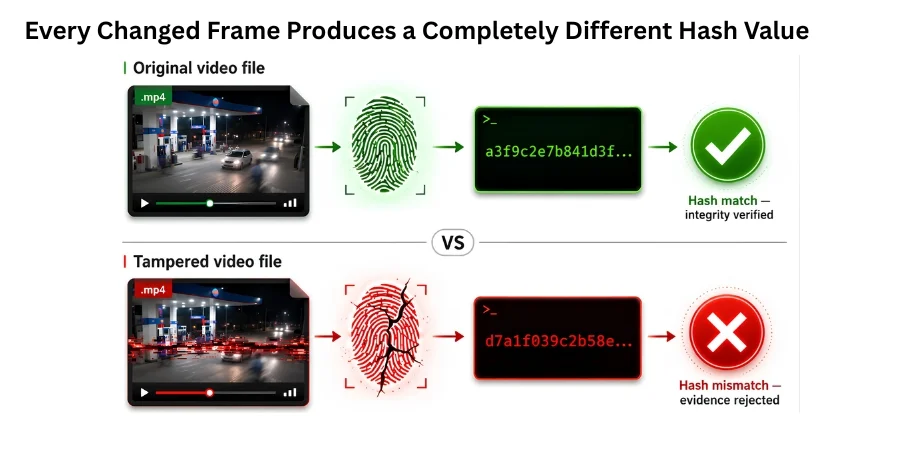
When court suspects tampering, forensic examiner generates the current hash of submitted video. It is then compared with original hash recorded at the time of extraction. Both matches means video is intact, and if not, video has been touched. This is the first test and takes just 25 seconds.
What Metadata Tells Court That Eyes Cannot
Beyond hash, every video carries metadata. Invisible data embedded in file like a postmark on a letter. Metadata records exact date and time of recording.
- Device model and Serial number.
- GPS information if available.
- File creation timestamp. (Everytime file was accessed, copied and modified after recording)
Forensic examiner reviewing metadata can tell whether video claiming to be recorded on 15th January, 2026. Was actually offered on 20 January, 2025 or not. They can tell a file submitted as original CCTV footage was re-exported from a laptop or not. They can tell whether device that recorded video matches device metadata in file.
Warning: Most Common Mistake: Never convert original CCTV footage from its native format (.dav for Dahua, .h264 for Hikvision) to MP4 using a third party tool before submission to police or court. This re-encoding strips original metadata and changes hash value. Courts treat this as tampering. Even when done innocently.
Frame-Level Analysis – Where Forgeries Can’t Hide
Sometimes tampering is more sophisticated. Editor removes three seconds from the middle of a clip. Then they re-encode the file carefully so timestamps can look right. Metadata has been cleaned.
Frames can still betray an edit. When a forensic tool analyses the video frame by frame. Just like handwriting expert examining each letter of a signature, not just the overall shape. It finds the inconsistency as the compression signature changes at exactly the point of the edit. One irregular pattern reveals forgery.
This is called Error Level Analysis and Codec Fingerprinting. These days Indian forensic labs increasingly use this in disputed evidence cases.
The Chain of Custody – The Signed Sealed Envelope
Even perfectly authentic, untampered video can be rejected. If its chain of custody is broken.
Chain of custody is the document, unbroken record of:
- Who handled the evidence.
- When they handled it.
- What they did with it.
We can think of it like a sealed envelope passed from person to person. Where every person is signing their name on it before passing it forward. If even one signature is missing, the court asks: What happened in that missing gap.
For video evidence in India, the chain of custody requires four documented steps:
Step1: Immediate incident log – The moment footage is identified as relevant, it must be logged in writing.
- Who saw it.
- When.
- What camera.
- What time range.
Step 2: Native format extraction: The footage to be exported in its original format directly from the NVR or DVR. No screen recording. No third-party conversion.
Step 3: Hash Generation and Physical Sealing: Immediately after extraction, the hash value is generated and recorded. The file burned to a write once medium, a CD or USB, should be sealed in a signed envelope.
Step 4: Receipt Handover: When an evidence is handed to police or submitted to court. Formal receipt is prepared listing the case number, hash value, time duration and signature of both parties.
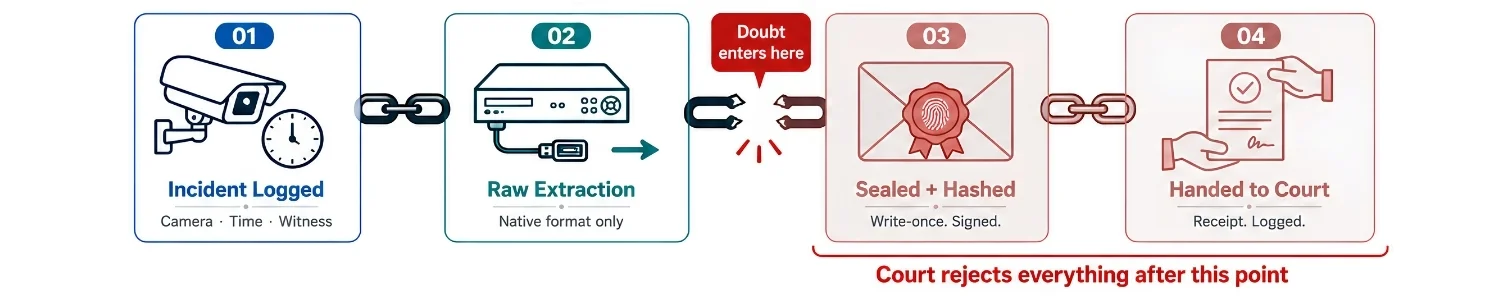
Broken Link anywhere in this chain creates doubt and a reasonable doubt is what a defence lawyer needs.
FACT CARD: In India, the most cited reason for video evidence being challenged in court is not content of a video. It is broken or undocumented chain of custody. The video exists. The video exists. The problem is no one can prove where it has been.
Related Read – What is Digital Footprint
The Legal Consequences of Submitting Tampered Evidence
What the Bharatiya Nyaya Sanhita 2023 Says
Submitting tampered video evidence is not just a failed legal strategy. It is a criminal offence.
The Bharatiya Nyaya Sanhita 2023 (BNS) – Treats evidence with severe consequences. While the AI Overview on Google says “severe penalties,” it stops there. Here are the exact sections and exact punishments:
- BNS Section 192: Fabricating Evidence: Intentionally creating false evidence for purpose of use in judicial proceeding. Punishment: Imprisonment up to 7 years + fine uptp 10000.
- BNS Section 193: Giving False Evidence: Providing false evidence in any stage if judicial proceeding. Punishment: Imprisonment upto 7 years. If false evidence leads to conviction in capital case, then imprisonment or life.
- Evidence Destruction – Destroying or concealing evidence to prevent it from being used in a legal proceeding. Punishment: Imprisonment up to 7 years + fine.
Consequences not only stops at criminal charges. Once tampering is identifies, the entire case is built on evidence collapses. Arguments that referenced the tampered video becomes void. Credibility of the party who submitted it is permanently damaged in that proceeding.
Deepfakes: The New Frontier Indian Courts Are Facing
This is a form of video manipulation that goes beyond cutting and splicing.
Deepfake Video – This is where artificial intelligence replaces person’s face, voice or actions in a video. This intelligence is now available to anyone with a laptop and internet connection. It has begun to appear in Indian legal disputes
Deepfake video submitted as evidence is not just tampered. It is entirely fabricated. Indian courts treat two differently. The law is clear on both.
Under BNS Section 318, using electronic means not cheat or impersonate someone. Which includes submission of deepfake as authentic evidence. This attracts charges of fraud by personation. The IT Act Section 66F further covers cheating by impersonation through computer resources.
Detection of deepfake needs specialised forensic analysis.
- Examining blink irregularities.
- Lighting inconsistencies across face and background.
- Audio frequency patterns that AI-generated voices produce differently from human speech.
Indian courts are developing jurisprudence on this rapidly. The safe assumption for any legal professional today is: If video evidence is disputed, forensic examination is no longer optional.
We hope from the information above you are geting some idea on admissibility of tampered video evidence in court.
Fact Card – Deepfake video can be created in under 4 hours, using publicly available tools. But BNS Section 192, 193 and IT Act Section 66D together form the legal net that catches it.
Verify Video Integrity Before It Reaches Court
Every forensic method described in this blog.
- Hash Verification
- Metadata Analysis
- Frame Level Examination
- Chain of Custody Documentation
Need purpose built tools to execute with precision court demands. Manual inspection is not only enough. As Human eye cannot read metadata, detect a codec fingerprint inconsistency at frame 1247 of a 90 minute recording.
MailXaminer is a professional-grade digital forensic tool, built for legal teams, investigators and compliance professionals. Who need to examine, verify and present digital evidence that can withstand cross-examination.
If you are a lawyer preparing to challenge the authenticity of CCTV footage, an investigator building a record of chain of custody. Compliance officer ensuring your organization;s digital evidence is court ready. You need to use the tools built for this purpose. We hope from the information above you are clear on admissibility of tampered video evidence in court.
Frequently Asked Questions
Q – Can tampered CCTV footage be used as evidence in India?
A – No, Under BSA Section 63, CCTV footage that is tampered with fails the integrity test for electronic evidence. Even if tampering was minor or unintentional. Court appointed forensic examiner will detect it. Footage will be rejected,
Q – What happens if someone submits fake video evidence in Indian court?
A – Under BNS Section 192, fabricating evidence attracts imprisonment up to 7 years. Under Section 193, giving false evidence in a capital case can result in imprisonment. The submitted evidence is rejected and entire case built on it collapses.
Q – How do forensic experts detect video tampering?
A – Forensic experts use four primary methods: hash value comparison (a changed hash proves the file was altered), metadata analysis (reveals when and how the file was modified), frame-level compression analysis (detects edits at the exact frame), and codec fingerprinting (identifies re-encoding after original recording).
- Forensic experts majorly use four primary methods:
- Hash Value Comparison (Changed hash proves the file was altered).
- Metadata analysis (Shows when and how the file was modified)
- Frame level compression analysis (detects edits at the exact frame)
- Codec Fingerprinting (Identifies re-encoding after the original recording)