What Is MD5 Hashing? Guide to Data Integrity Verification


Blog Overview – In your investigation, you found an email that can prove a fraud case. Everything looks completely normal. But one question stops you. You ask, can I prove this email has not been changed. This is where most people get stuck. You have data but not a proof. In this blog, you will completely understand what is MD5 hashing. How it works and why it plays a significant role in the protection of digital evidence.
What is MD5 Hashing and How It Works
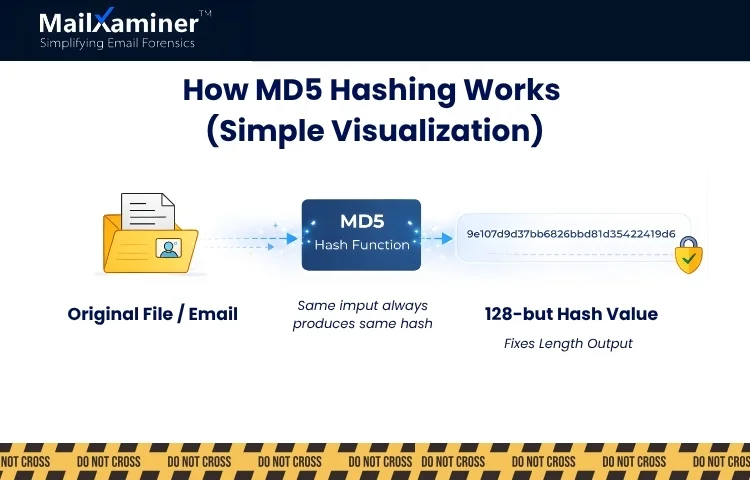
First, let us answer the main question: What is MD5 hashing?
MD5 hashing is a method which converts a file, text, or an email into a fixed-length unique code called a hash value. For better clarity, it can be thought of as placing any document on a machine, and the machine gives you a unique barcode.
- Same document – Same barcode.
- Even a smallest change – Completely different barcode.
The point to be remembered is this:
- MD5 does not store the original data.
- It only creates a unique identity for it.
Instead of reading the entire file data again and again. You just compare the hash values.
Note – MD5 hash is a 32-character string in hexadecimal format, using digits (0–9) and lowercase letters (a–f)
Role of MD5 Hashing in Email Forensics
In investigations, digital evidence must be authenticated and unaltered in order to be accepted by the court. Now imagine a courtroom where:
One party has submitted an email as proof in a legal case. The other party claims it is edited. Now, how can this be proved?
This is where MD5 hashing helps. It acts as a digital seal of trust. If the hash value of the proof, in our case, it is email matches the original. This means the file is untouched. If it does not match, this means something has changed. This process is the backbone of email forensics, corporate investigations, and legal validation.
Understanding MD5 Hashing Simply
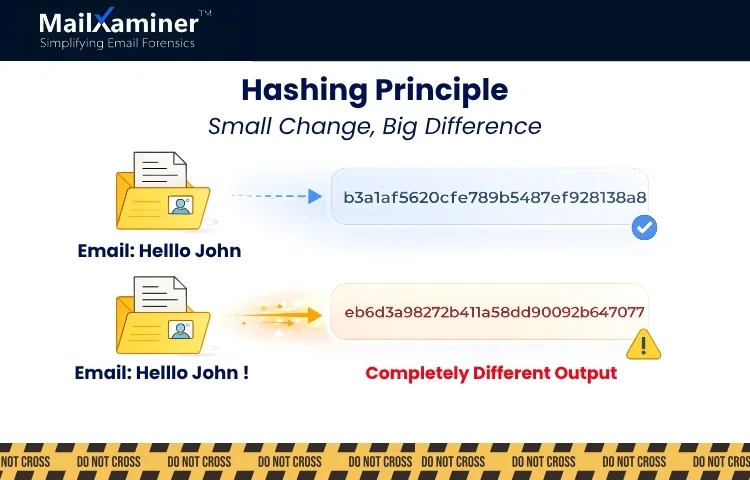
You know what is MD5 hashing to bring more clarity, let us understand in a non-technical way.
Imagine baking a cake. You follow a fixed recipe, same ingredients, quantity, and steps. Every time you follow the same recipe, the cake tastes the same.
Now, this time, you just added one extra spoon of sugar, and the taste changes. MD5 hashing works on the same mechanism.
- The same input leads to the same output.
- A small change completely leads to a different output.
In this case, even if someone changes one word in an email. MD5 hash will change completely.
How MD5 Hashing Detects Tampered Emails
In email forensics, professionals use a simple way to detect tampered emails.
- When the original email is collected to be investigated. Its MD5 hash is generated.
- When an email is reviewed, a new hash is generated.
- Both the hash values are compared.
If both values match, that means the email is authentic. If they don’t means an email is modified. This makes MD5 hashing a reliable method to verify data integrity. There are several methods on how MD5 hash can be generated let’s throw some light on it.
Related Read – Need for forensic hash algorithms in digital crime investigation
Manual Methods to Generate MD5 Hash
There are different ways to generate an MD5 hash manually. Many investigators often use.
- Command Prompt tools (CMD)
- Basic hashing utilities.
- Online hash generators.
These methods work, but they can be challenging:
- One has to process files one by one.
- For large datasets, this process becomes confusing.
- Higher chances of human error.
- Structured reporting is missing.
The manual process is manageable for small files. It is not convenient for large investigations that involve thousands of emails. We hope from the above information you now know what is MD5 hashing.
A Smarter Way to Handle Email Evidence
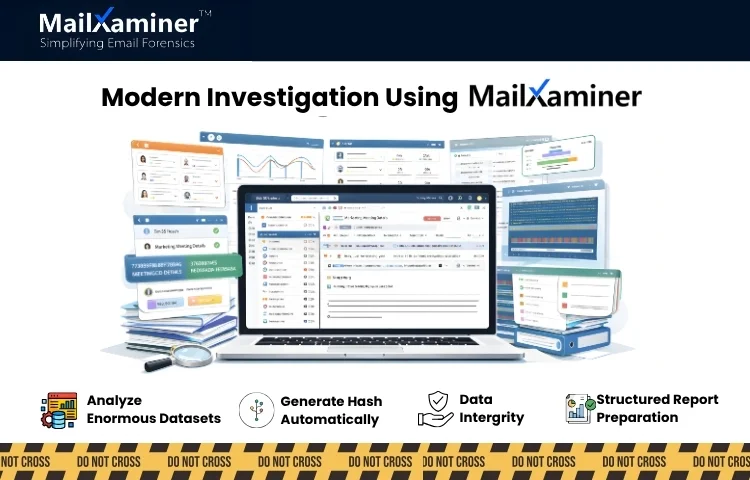
Imagine you have to investigate a giant dataset of a huge corporate espionage investigation. Manually checking and inspecting each file is like reading every word of every page of a fat-sized book to check if it has changed or not. It is slow and exhausting. This is where a smarter approach comes in. Instead of doing everything manually, professional investigators use tools that can:
- Analyze large data sets of digital evidence.
- Generate hash values automatically.
- Verify the integrity and authenticity of the data instantly.
- Prepare structured reports.
One of the efficient solutions to perform all this is MailXaminer, which simplifies investigations by handling hash analyses as part of a larger forensic process. Instead of jumping between multiple tools. It helps you:
- Analyze
- Verify
- Organize
Email evidence in one place, making you work faster and more reliably. From the above data now we completely know what is MD5 hashing and how it can be generated efficiently.
Related Read – What is corporate espionage investigations
Common Mistakes Regarding MD5 Hashing
The MD5 hashing concept is clear now; some misconceptions related to this also need to be cleared, which are as follows.
- MD5 is not an encryption; it does not hide data.
- Original content can never be recovered through it.
- It should always be generated at the right time (initial evidence stage)
- It should always be stored securely for comparison.
Understanding just these basic points can prevent costly errors.
Quick Check
One should always ask oneself:
- Can I prove this email evidence hasn’t been altered?
- How can multiple files be quickly verified?
- How can my findings stand in a legal review?
If you feel confused in answering any one of these question then relying on only one basic method is not enough.
Pro Tip
What is MD5 hashing? MD5 hashing is not about your data protection. It is all about proving your data is original and unchanged.
Concluding Remarks
Deeply understanding what is MD5 hashing is not just a technical skill. It can be seen as a trust-building mechanism. In the digital world, having data is very easy; providing authenticity is what truly matters. Whether you are handling a simple file or a critical investigation, MD5 hashing ensures that what you are seeing is exactly what was created. In the legal world, accuracy matters. Using the right approach makes all the difference.
Frequently Asked Questions (FAQs)
Q – What is MD5 hashing algorithm?
A – MD5 hashing algorithm is a method that converts digital data, like email, file, or text, into a fixed 32-character string called a hash value. This code is the unique identity of that data. If even a single character changed hash value also changes. Making it easier to detect.
Q – How do cloud storage services use MD5 hashing for data integrity?
A – Cloud storage uses MD5 hashing to ensure that files remain unchanged during the upload and storage time. When we upload a file, the system generates an MD5 hash. Later cloud storage services recalculate the hash and compare it with the original. If both match, the file is intact. If not, it indicates data corruption or alteration during transfer.
Q – Why is MD5 hashing used in cybersecurity?
A – MD5 hashing is used in cybersecurity for data verification. It helps ensure that digital evidence has not been altered. It is widely used in forensic investigations and system checks to confirm that the evidence is original and trustworthy.