Role of Artificial Intelligence in Digital Forensics: Applications, Benefits and Challenges


Quick Answer: Role of artificial intelligence in digital forensics is vital as it helps investigators examine:
- Large volumes of digital evidence.
- Identify patterns.
- Prioritize relevant artifacts.
- Work through complex investigations more efficiently.
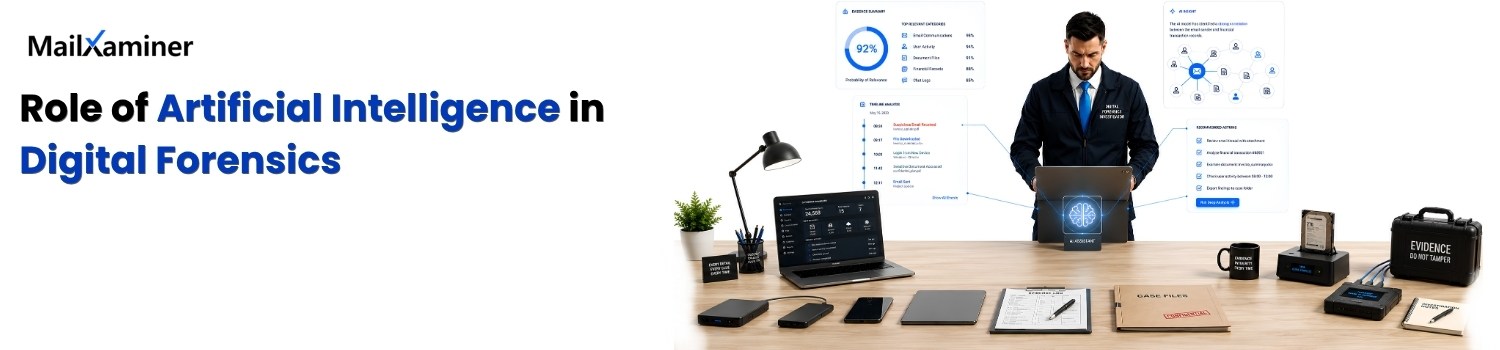
AI cannot convert forensic investigation to an automatic process. It equips investigator with better ways and tools to find, organize, compare, and understand evidence while human investigators will remain responsible for validation, interpretation, and conclusions. Digital evidence can belong from different sources like:
- Computers
- Mobile devices
- Cloud environments
- Emails,
- Images, videos, applications, and other connected systems.
NIST notes that growing volume and different forms of digital evidence make reliable acquisition, preservation, and analysis increasingly important.
What AI Do in Digital Forensics
AI in digital forensics helps investigators process evidence at faster rate by automating or assisting with tasks like:
- Classification
- Evidence triage
- Pattern detection
- Anomaly identification
- Text analysis, and correlation.
Investigation contains hundreds and thousands of files and messages. Investigator cannot treat every item with equal importance. AI can help narrow that collection and bring relevant information to the investigator’s table. Final decision will belong to investigator only.
This distinction is important because forensic evidence must be handled, analyzed, and interpreted that can withstand independent scrutiny. ISO/IEC 27042 specifically says that continuity, validity, reproducibility, repeatability, and sufficient documentation of digital evidence analysis. This is the role of artificial intelligence in digital forensics.
How AI Fits Into a Digital Investigation
These days AI works as a smart layer inside forensic workflow rather than a replacement for the workflow itself. Investigation can move from identification stage to examination and analysis, faster. AI can assist with several activities in middle of the process chain, especially when evidence volumes become difficult to review manually. For example:
- AI can help classify thousands of documents.
- Detect unusual communication patterns.
- Identify related files.
- Surface messages that match investigation’s criteria.
But AI should not be allowed to change underlying evidence or turn an unverified prediction into a forensic conclusion. This is the reason the investigators have to be more careful now. Evidence handling requires controlled procedures and appropriate validation.
ISO/IEC 27037 provides guidance for identification, collection, acquisition, and preservation of potential digital evidence.
Related Read: How to Manage Organizational Communication
Artificial Intelligence in Digital Forensics: Evidence Triage
AI reduces major burden in a forensic investigation: deciding where an investigator should look first. Evidence triage means quickly sorting or prioritizing large evidence set so potentially relevant items receive needed attention.
AI can assist via classification of artifacts, recognizing patterns, detecting similarities, and ranking items according to defined investigative criteria. Think of an investigation containing 500,000 files. Human examiner may need to spend substantial time locating the small percentage that deserves closer examination. AI-assisted system can help narrow that collection.
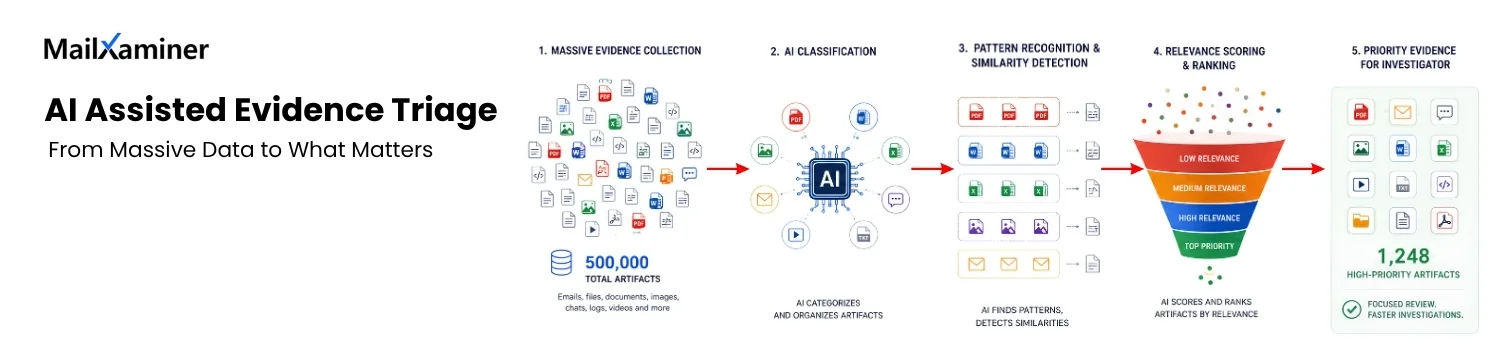
The purpose is not to declare that the highlighted items are evidence of wrongdoing. Purpose is to help an investigator find potentially important material sooner.
Artificial Intelligence in Digital Forensics: Evidence Triage
AI reduces big burden in a forensic investigation: deciding where an investigator should look first. Evidence triage means quickly sorting or prioritizing large evidence set so potentially relevant items receive needed attention. AI can assist via classification of artifacts, recognizing patterns, detecting similarities, and ranking items according to defined investigative criteria.
Think of an investigation containing 500,000 files. Human examiner may need to spend substantial time locating the small percentage that deserves closer examination. AI-assisted system can help narrow that collection. The purpose is not to declare that the highlighted items are evidence of wrongdoing. Purpose is to help an investigator find potentially important material sooner.
Related Read: How to Trace an Email Address to Its Owner
Pattern and Anomaly Detection
AI can recognize patterns that can be difficult to spot when evidence is distributed across thousands of records. For instance, investigation involve login events, file access, email exchanges, and network activity. Individually, each event looks ordinary. If investigated collectively their timing and relationship reveals unusual behavior.
Machine learning and anomaly-detection techniques can help identify activity that is different from an expected pattern. This can be useful for investigations involving:
- Unusual access behavior
- Repeated activity among systems
- Abnormal communication patterns
- Unexpected file activity
- Suspicious trail of events
- Relationships between seemingly unrelated artifacts
Limitation is simple: an anomaly is signal, not conclusion. Unusual event may have legitimate explanation. Investigator has to examine the underlying evidence and context.
Natural Language Processing for Digital Evidence
Natural language processing, or NLP, allow AI systems to work with human language. In digital forensics, this can be useful because investigations involve
- Emails
- Chat messages
- Documents
- Notes
- Search queries
- Other text-based evidence
NLP assist with tasks like identifying entities, grouping similar messages, finding relevant language, summarizing large collections, and connecting related conversations.
For example, investigator examining thousands of emails search for references to a person, project, location, transaction, or event. NLP can organize that information and reveal relationships across collection. Investigator then reviews relevant messages and determines what evidence shows.
Image, Video, and Multimedia Analysis
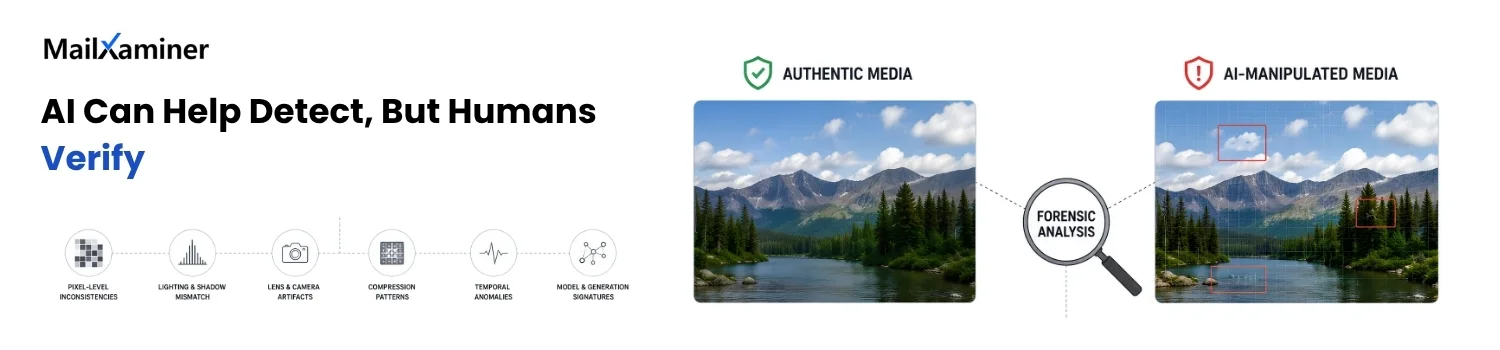
AI is also applied to image and video evidence. Computer vision techniques helps in identification of objects, faces, scenes, visual similarities, or other characteristics within large media collections. This reduces manual review when investigators are dealing with large number of images or videos. This is one of the major role of artificial intelligence in digital forensics. However, multimedia evidence introduces another challenge: synthetic and manipulated content.
NIST’s Guardians of Forensic Evidence program is focused on evaluation of forensic technologies for AI-generated deepfakes and synthetic media. Program addresses concerns about generalization, robustness, benchmarking, and real-world performance.
Generative AI and Large Language Models
Generative AI introduces newer layer to digital forensic analysis. Large language models can assist with tasks such as:
- Evidence summarization.
- Natural-language querying.
- Document analysis.
- Investigation support.
- Explaining technical information.
Research published in 2025 describes LLM applications across digital forensic tasks while also highlighting concerns that Generative AI has such as, hallucinations, interpretability, bias, ethics, transparency, and standardization. This makes LLMs useful as investigative assistants, but risky if unsupervised by investigators properly.
A useful way to think about it is:
Ask AI to help you find and organize the evidence. Do not ask AI to replace evidence and make decisions on behalf of you.
AI in Email Forensics
Email is useful example of how AI-assisted forensics can solve a practical investigation problem.
An email collection contains:
- Messages
- Headers
- Timestamps
- Attachments
- Sender and recipient relationships,
- Thread histories,
- Metadata.
Challenge is often not finding data, but finding right data in right context. AI can assist with message classification, semantic search, communication-pattern analysis, entity extraction, anomaly detection, and large-scale email triage. For investigator, this mean moving more quickly from large mailbox collection to the conversations, attachments, people, and timelines that demand closer examination.
To make email forensics simple there are professional email forensics software like MailXaminer which makes investigation of emails simple so evidence extraction becomes simpler for investigators.
Cloud, Mobile, and Connected Evidence
Modern investigations do not stay in one device. Evidence gets distributed across:
- Smartphones
- Laptops
- Cloud services
- Applications
- Connected devices
- Online accounts.
NIST identifies mobile devices, cloud environments, and multimedia data as important area of modern digital evidence and forensic research. AI helps correlate information across these sources.
Where AI Still Needs Human Judgment
AI can analyze patterns quickly, but forensic interpretation requires context. Model can identify an unusual login. It can group similar emails and flag a file as suspicious. None of these actions, by themselves, establish what happened.
Investigator should ask:
- What is the source of this result ?
- Can the underlying evidence be verified ?
- Could another explanation produce same pattern ?
- Can this method be repeated and independently examined ?
These questions are important because a 2025 practitioner study involving digital forensic experts identified validation, transparency, and explaining AI-generated evidence as major practical barriers to AI adoption in digital forensics. We hope the role of artificial intelligence in digital forensics are now clear.
Wrapping-Up
AI makes digital forensic work faster, and especially when evidence collections become too large or complex for efficient manual review. In this situation role of artificial intelligence in digital forensics is extremely important. Speed is not same as forensic validity.
Strongest approach is to use AI for tasks where it creates measurable value, preserve the underlying evidence, document how the technology was used, validate important outputs, and keep qualified human investigators responsible for interpretation and conclusions.
That approach also reflects the direction of current practitioner research, where validation, transparency, standardization, and explainability remain central concerns for responsible AI adoption in digital forensics.
Frequently Asked Questions
1. What is the role of artificial intelligence in digital forensics?
Artificial intelligence helps investigators analyze, classify, prioritize, and correlate big data of digital evidence faster. It supports forensic analysis but do not replace human validation and judgment.
2. How is AI used in digital forensics?
AI is used for evidence triage, anomaly detection, pattern recognition, NLP-based text analysis, multimedia examination, and cross-source evidence correlation. These capabilities help investigators focus on potentially relevant evidence more efficiently.