How Can Digital Forensics Be Used in Criminal Investigations


Blog Overview – Think you are in the middle of a criminal investigation. Evidence that needs to be extracted is scattered across emails, chats, devices, and digital footprints. When performing analysis on it, nothing connects clearly. Investigators often face this frustration. To solve this smoothly, you will be learning the ins and outs of how can digital forensics be used in criminal investigations.
As one missed email or an unnoticed detail can weaken the entire case and delay justice. You are about to experience how experts unwrap digital data for evidence, connect the dots between the suspect, and turn highly complex data into a strong court-admissible proof.
Why Criminal Investigations Are Failing Without Digital Forensics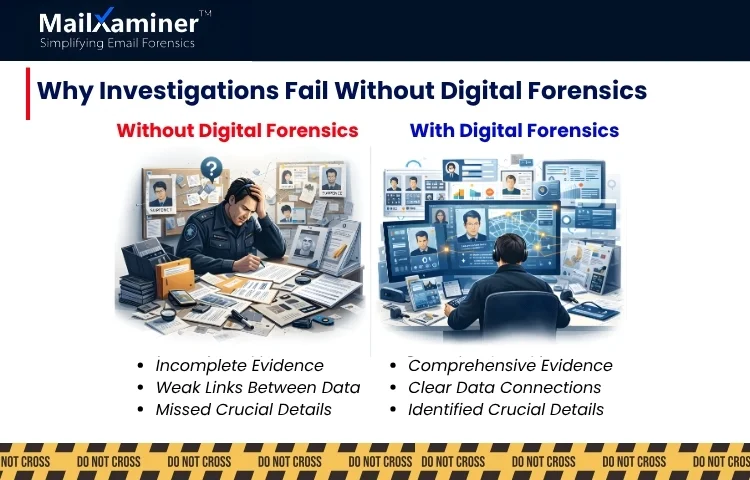
Crimes don’t only take place in the physical world anymore. They live in emails, cloud apps, and hidden files. This means the larger part of the evidence is invisible without the right methods to uncover it. Criminals use several methods like fake identities and encrypted communication, to hide their actions.
Without digital forensics, investigators rely on incomplete information that leads to delays and weak case outcomes. Digital forensics plays the role of a high-powered flashlight in a dark room, by uncovering the hidden data, tracking digital dots, and conversion of scattered information into clear, verifiable evidence that can be used in court. Now let’s explore how can digital forensics be used in criminal investigations.
How Digital Forensics Is Applied in Criminal Investigations
Digital forensics is not a technical process. It is a structured way through which investigators turn scattered digital data into reliable evidence. Each stage has an important role in building a case that is not only accurate but also legally valid. Let’s check out how the process is.
Securing Digital Evidence Without Alteration
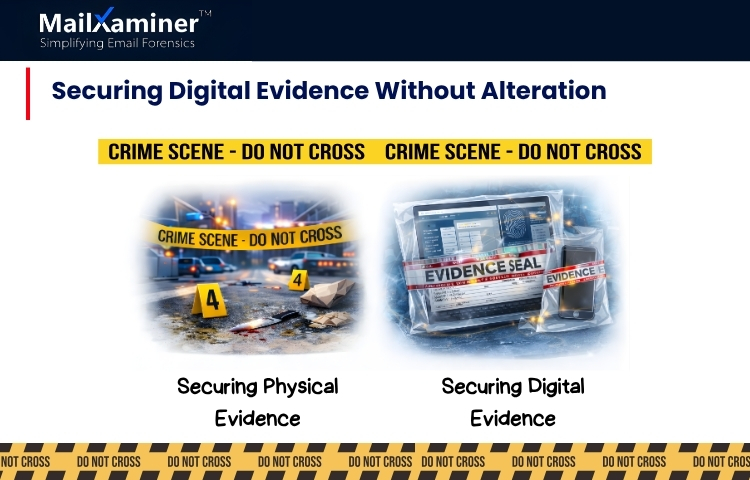
The process starts where investigators start by data collection from emails, devices or storage systems in a highly controlled manner. The goal is simple: capturing evidence exactly as it is without modification.
For more clarity, it is like sealing a crime scene. If even a minor element is disturbed, the evidence loses credibility. In the digital world, even a small change can raise a question in court. Preservation cannot be left to chance, and it starts from the point data is collected. This step has high importance in how can digital forensics be used in criminal investigations.
Maintaining Evidence Integrity for Legal Use
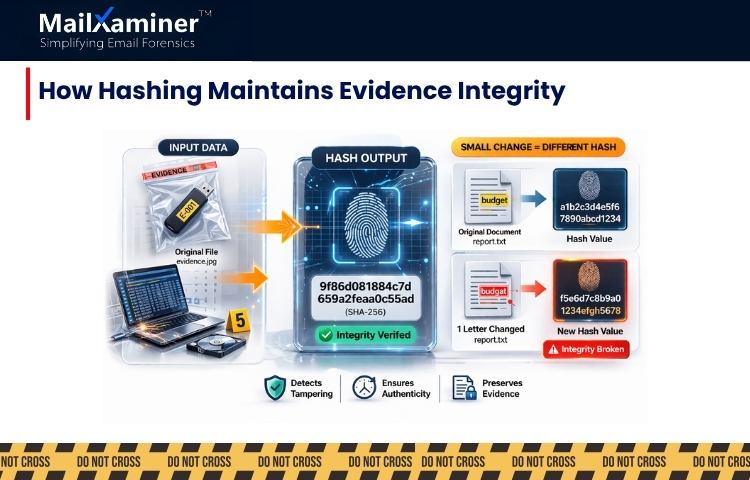
Once the evidence is collected, it should remain unchanged and verifiable. Even a small alteration can make it invalid. For this, the investigators use hashing to generate a unique digital fingerprint of the data. Even if a small part of the data changed, the fingerprint changes, proving tampering.
Why it matters:
- Detection of unauthorized changes.
- Maintains a clear chain of custody.
- Evidence acceptability in court.
Related Read – What is MD5 Hashing.
Deep Analysis of Hidden and Complex Data
Once the evidence is secured. Investigators start performing a detailed analysis to uncover meaningful and legally relevant insights from raw digital data. This stage helps investigators find out patterns from behaviors and hidden information across different digital sources.
This includes examination of:
- System logs and user activity for tracking actions performed on devices.
- File systems for the detection of hidden, modified, and deleted data.
- Network data for tracing connections, access points, and communication flow.
- Metadata like timestamps, locations, and device identifiers.
This stage in the process of how can digital forensics be used in criminal investigations. Transforms scattered data into structured intelligence. What appears as individual information starts revealing patterns, timelines, and intent. This alone helps the forensics team build a stronger evidence-backed case.
Related Read – How is digital evidence preserved without loss of its legal value
Linking Evidence to Build a Clear Case Narrative
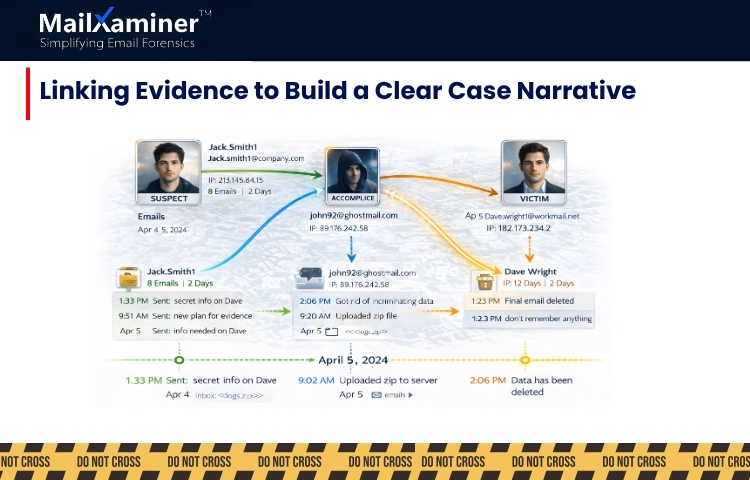
The final stage in the process of how can digital forensics be used in criminal investigations is to correlate all findings into a clear and evidence-backed timeline. This step converts fragmented data into a logical sequence that clearly explains what happened, when it happened, and who was involved. In this step, investigators focus on:
- Establishing connections between individuals, devices, and accounts.
- Mapping timelines using timestamps and activity logs.
- Identification of behavioral patterns that indicate intent or anomalies.
This effective correlation converts isolated data into a coherent narrative supported by verifiable evidence. Due to this, investigators can present findings that are clear, consistent, and defensible.
Related Read – Current Challenges in Digital Forensics Investigations
The Biggest Hurdles in Digital Forensics Investigations Today
We know modern investigations depend on digital evidence. While the data to be investigated is large, scattered, and complex to analyze. Which exists across multiple platforms, and as per our research, emails remain a major component due to their communication trails, attachments, and routing details.
The real challenges in digital forensics investigations for an investigator is not finding the data. Turning it into clear, usable, and legally valid evidence. Without proper tools:
- The investigator’s work becomes slow and inefficient.
- Critical evidence gets missed.
- Findings are not up to the mark to meet legal standards.
- Connections between suspects remain unclear.
Digital forensics and proper tools solve this by converting data into structured and reliable evidence.
Related Read – How to maintain the chain of custody for digital forensic evidence
A Smarter Digital Forensics Approach
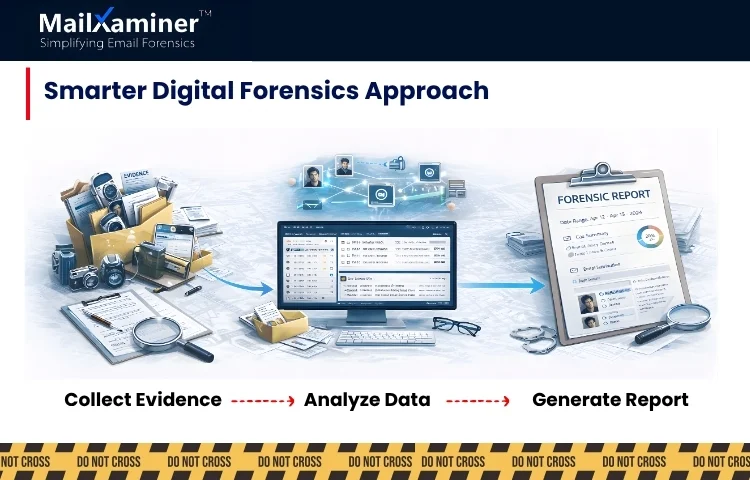
In cases where email evidence has an important role, MailXaminer steps in and simplifies the process.
- It enables investigators to analyze large volumes of email data.
- Uncover communication patterns and relationships using link analysis.
- Extraction of relevant evidence without altering it.
- Generation of a structured and court-ready report.
This approach transforms complex and scattered data into a clear, organized, and legally usable form, making complex investigations faster, accurate, and easier to present.
Final Thoughts
Criminal investigations today are no longer about physical evidence. They are now driven by digital truth. The real challenge is not data shortage but the ability and efficiency to find, understand, and present it with clarity and legal confidence.
Understanding how digital forensics is used in criminal investigations gives investigators a clear advantage. It helps transform scattered traces into a structured court-admissible evidence.
Frequently Asked Questions
Q – How can digital forensics be used in criminal investigations?
It helps investigators in different ways like tracing digital activities, uncover hidden or deleted data and convert it into clear and court-admissible evidence.
Q – Why is digital evidence critical in modern investigations?
In this digital-era most crimes are planned electronically which are wrapped in coded words in emails, online activities, mobile phones. This makes digital evidence critical in modern investigations.
Q – What makes digital evidence valid in court?
Evidence must be collected, preserved and verified properly to ensure it remains unchanged and acceptable.