Role of Digital Forensics in Commercial Litigation: Turning Digital Evidence into Courtroom Wins


In a courtroom, a high-stakes business lawsuit is about to be decided. Everyone in the courtroom senses that truth exists. This truth is buried inside thousands of emails. It is buried inside thousands of emails. Many of them are altered or hidden in plain sight.
The real question is: How can one find an email that changes everything? In this blog, we will talk about the role of digital forensics in commercial litigation and will walk you step by step through the process.
Role of Digital Forensics in Commercial Litigation
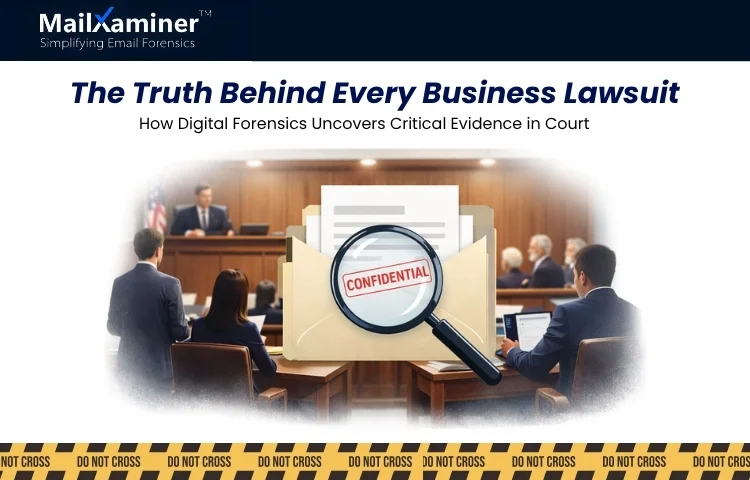
The role of digital forensics in commercial litigation is to locate, protect, and present the evidence in such a way that courts find it trustworthy. These days, business disputes or cases are decided by digital footprints and not only by contracts and witnesses. In digital footprints, the most common pieces of evidence are emails, attachments, timestamps, and hidden metadata. In these evidences, emails act as silent witnesses.
Why Digital Evidence Wins Modern Cases
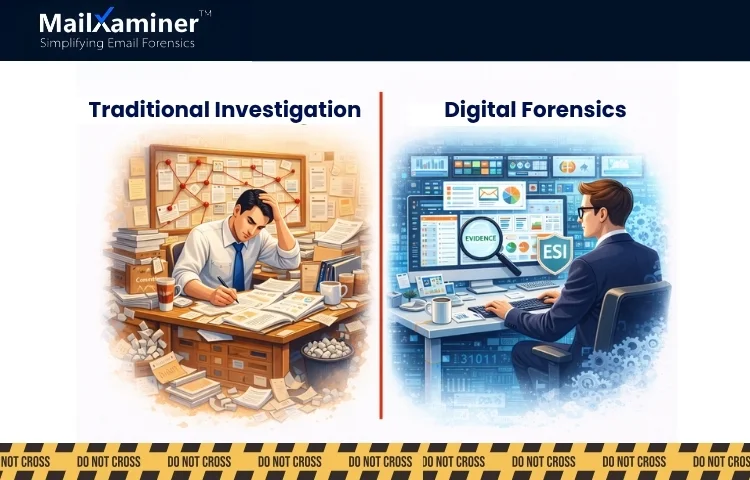
Years before, legal battles in courtrooms were fought on the basis of paper documents. Today, everything happens digitally, like an email. deals, approvals, conflicts, and even fraud. Now, the crimes and dispute-oriented communication are mostly executed digitally by the criminals, so courts trust electronically stored information (ESI). Sometimes, in court cases, strong digital evidence can be enough to pronounce the sentence. We can think of it like a single email thread can prove intent and expose manipulation.
To extract evidence from the digital information, digital forensics plays a huge role. As it turns scattered data into a clear, court-ready truth.
Where Investigations Fail Without the Right Tools
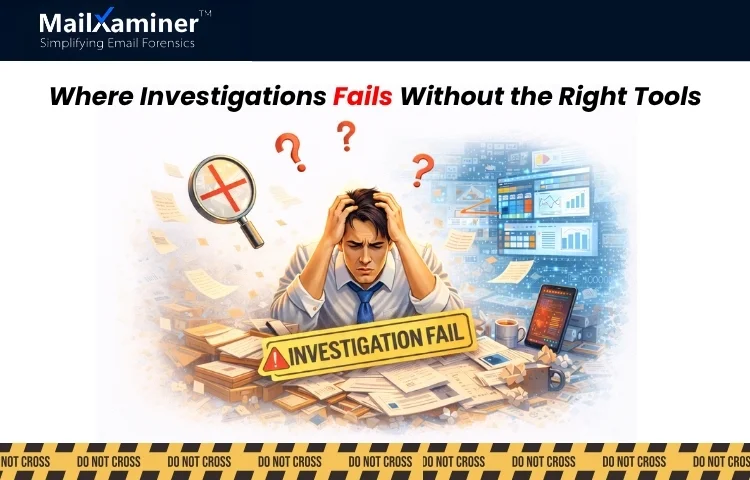
Now imagine missing one critical email that could have won the case. That’s not just a mistake. That’s a lost opportunity.
Here is the harsh reality. Most investigators fail not because the evidence is missing in the information, but because it is not found within the given time. Common problems are as follows:
- Emails deleted or hidden.
- Digital data is spread over multiple platforms and formats.
- Volumetric data that has no clear starting point.
- Tight legal deadlines.
Consider email as an example that one critical email could have won the case. This is not a mistake; it can be seen as a lost opportunity. We think now you have start observing what is the role of digital forensics in commercial litigation.
Related read – What is email bombing in cybercrime.
Real Challenge in Digital Forensics: Finding Evidence in Emails
Emails are not just simple files. They are layered. Each email contains.
- Content (what you see)
- Attachments (the hidden value)
- Headers (technical routing details of an email)
- Metadata (timestamps, sender paths)
Finding one key detail in the form of evidence among thousands of emails is like searching for one sentence in the years of chat history. What investigators do is they keep investigating emails manually. Without the proper tools, it becomes overwhelming. First, let us look at what many investigators do.
Manual Investigation (Slow and Risky)
Let us break down the manual method that investigators follow, which is good if the emails or digital information to be investigated are limited or small.
An investigator:
- Opens emails one by one.
- Reading of threads manually.
- Checking attachments separately.
- Tracking timelines.
- Analysing headers and routing paths.
This process is not slow. But as it is human-oriented and in large volumetric data management, it can become error-prone. To make this process smart and error-free, tools like MailXaminer step in and make the process automated.
| Task | Manual Method | Smart Tool |
|---|---|---|
| Email search | Time consuming | Instant |
| Structured dashboard | No | Yes |
| Evidence organization | Messy | Structured |
| Court readiness | Risky | Reliable |
The manual method can be seen as less reliable when compared with a tool-based approach.
Hidden Risks That Can Lose the Case

The role of digital forensics in commercial litigation is very important, and it influences the decision of a court. The approach in evidence extraction should be precision-oriented. As manual investigation includes serious risks:
- Missing critical evidence.
- Overlooking emails that looks non-important.
- Data authenticity questioned in court.
- Breaking the chain of custody.
In courts, if evidence is handled in a proper manner. It can be rejected completely. This means even if we had a truth. We can still lose.
Related read – How to write a digital forensic report
The Smarter Way
This is where a specialized solution like Email Forensics Software in the email forensics department steps in. These tools act as a mission control system. They research the uploaded data, scan, filter, and highlight what truly matters. When an investigator investigates data with these tools.
- They don’t chase data anymore.
- Specialised tools research and brings evidence to them.
We can think of these tools like Google for forensic purposes. Investigators can:
- Search across thousands of emails instantly.
- Filter by keywords, dates, and users.
- Identification of important conversations quickly.
The professional approach can be thought of as a confusion remover and clarity giver.
Ensuring Evidence Trust in Court
Carving out evidence from a warehouse of information is only half the job. It must be trusted and acceptable in court; there are some pointers that an investigator should keep in mind.
- MD5 Hash – This works like a digital fingerprint. Even a small change in the evidence changes the hash, and this compromises the integrity.
- EDRM Compliance – We have to ensure that evidence is collected and presented as per the legal standards.
- Secure Handling – It keeps data protected and unchanged during an investigation.
These important elements ensure the found evidence is legally reliable.
Handling Large-Scale Investigations
Modern investigations involve cloud data and large systems. As investigators deal with:
- Cloud-based communication platforms.
- Giant volumes of enterprise data.
- Multi-user-based environment.
Advanced solutions allow teams to work together, handling large datasets, and ensuring no digital footprint is missed. When we work with professional tools, evidence can also be exported with Bates numbering, custodian tagging, and in formats like PDF and CSV, which makes it perfectly ready for legal submission.
Final Thoughts
The role of digital forensics in commercial litigation is just like the role of air in a car tyre, which is not at all optional. It is essential. Now, in court cases, cases are not won by who speaks better; they are won by presenting clear and reliable evidence. The selection of the right approach becomes extremely important, as with the right approach, investigators don’t just investigate; they carve out evidence that is true and can be presented.
Frequently Asked Questions
Q – Why are emails important in legal investigations?
A – Emails are a digital record of communication that has happened. When investigated properly, it shows timelines and hidden actions clearly.
Q – How can investigators ensure that digital evidence is accepted in court?
A – Digital evidence can be accepted in court if data integrity is maintained using hashing, proper handling, and following legal standards like EDRM.
Q – What is the role of digital forensics in commercial litigation?
A – Digital forensics helps preserve and present digital evidence so courts can trust and use in decisions.